
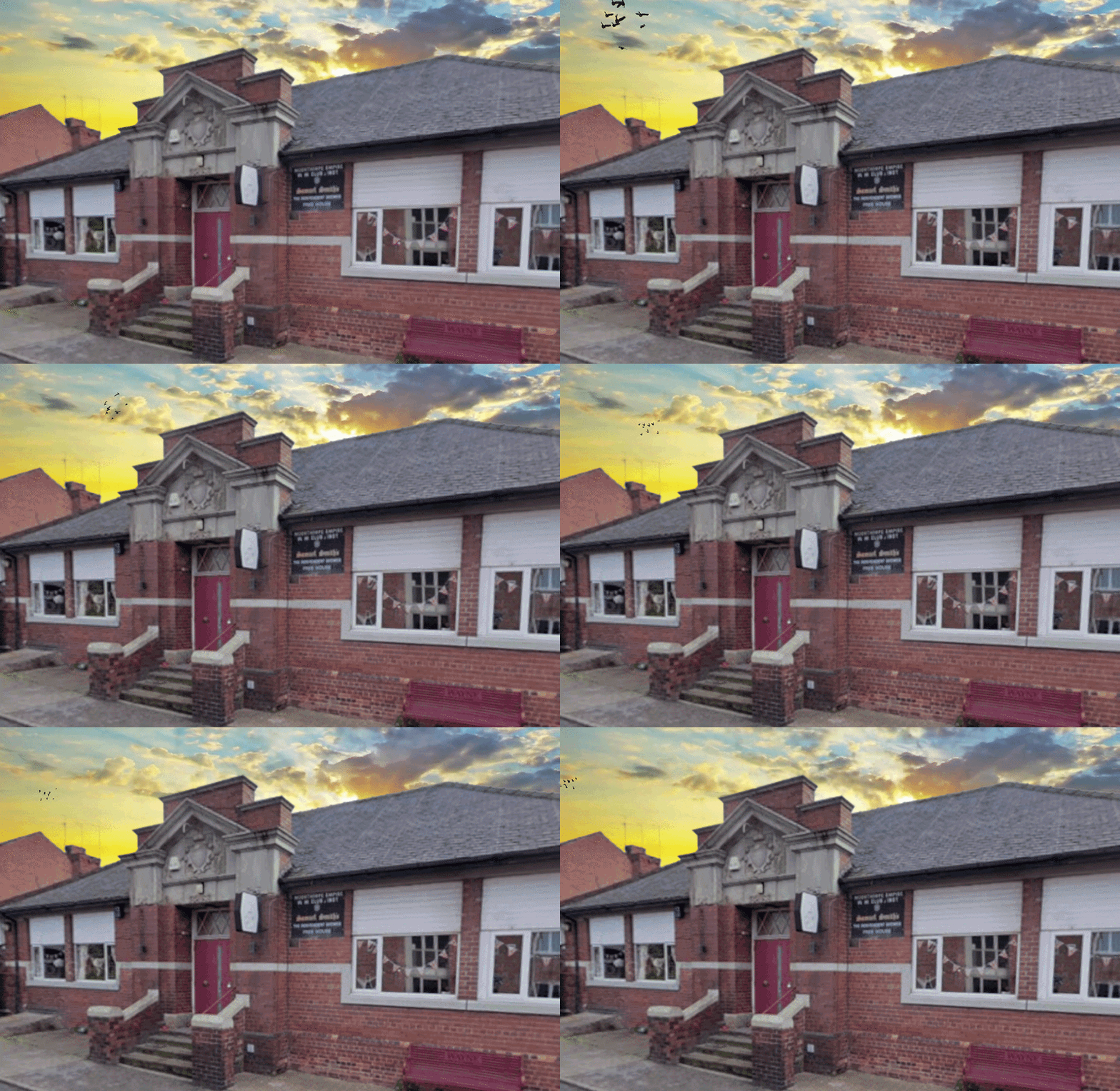
Another building that is located in the village of Moorthorpe, part of the parish of South Kirkby and Moorthorpe but associated with South Elmsall due to it’s close proximity is the Empire Working Men’s Club and Institute, which was opened on Saturday the 4th of July 1914, by President Mr J. Murgatroyd. The Sheffield Daily Telegraph noted, on Monday 6th of July 1914, that the new club was “one of the most elaboratively fitted in the district” and included a large hall, a billiard room, a library, a recreation room, a smoke room and a committee room, amongst it’s premises.
The external front elevation of the club building, to this day, features an elaborately carved stone doorway and porch, fully in keeping with the one above the entrance to the nearby Miner’s Institute, and the buildings together should by all rights form the centre of a local heritage plan to preserve those features. The billiards room evidently was a big draw for members, as by 1917 the club was competing in the National Trophy of Billiards, as reported by the Barnsley Chronicle on Saturday the 3rd of March 1917. Key players that year included J. C. Smith, J. Webster and W. Charlesworth.
1921 closed in horrific fashion for the regulars of the Empire, with the death of 39 year old miner, Charles Keogh, from a £1 per side bet. The Hartlepool Northern Daily Mail reported, on Saturday 31st of December 1921, that Charles had returned to his nearby home, on Phoenix Street, on the afternoon of December the 17th, telling his wife, Anna, that he was going to fight the next morning. A witness, named Charles Grice, told police that Charles had repeatedly challenged named Albert Barber, who was reluctant to take up the offer, to a fight whilst the pair were drinking in the club.
The Hartlepool Northern Daily Mail reported that witnesses had said the pair were on friendly terms, however, the Stapleford & Sandiacre News of Saturday 14th of January 1922 contradicted this, as it’s own coverage noted that there had been a dispute between the two, in the club. The two combatants were apparently on good terms. Another witness, Francis Barraclough, noted that the bareknuckle fight took place in a field on Westfield Lane. Acting as a referee, of sorts, Francis told police that the fight was arranged to consist of three one minute rounds, or until one of the men submitted to defeat.
During the battle Charles suffered an injury to his neck, with repeated blows, and was heard to exclaim “you have broken my neck” and admitted defeat, before collapsing. Charles remained unconscious for around fifteen minutes, and on recovering he shook hands with Albert, who apologised to Charles for the injury. Witnesses gave evidence that Charles needed no help to get home, and the doctor was only called some days later, when Charles was complaining of severe pain to the head. Charles subsequently collapsed and never recovered, with death being attributed to “syncope” following concussion (fainting), and meningitis, which had developed due to brain injury.
Albert was ultimately charged with manslaughter and brought before the courts in Pontefract, but a verdict of death by misadventure was reached. Club life was intricately intertwined with the local collieries, often leading to bad blood between miners who were members. For example, Christmas of 1926 saw fifteen members of the club expelled en masse because they dared to return to work before an official settlement of a work dispute had been arranged. The Leeds Mercury of Friday 31st of December 1926 reported that the expulsion of the men had been decided by an extraordinary meeting of fellow members, but the committee quickly reversed the decision before new year, with the Working Men’s Club and Institute Union advising the club that the reason for the expulsion was not legal.
By 1938 the club was doing a roaring trade, so much so that suspicion was raised into the activities of it’s members, leading to a “plain clothes” investigation and a call to strike the club off. The Yorkshire Evening Post of Saturday the 10th of December 1938 laid bare that officers investigating had noted many occasions where hundreds of non-members had been admitted, a clear breach of the rules, and summons were issued against club officials. Joseph Mellows, the steward, and Ivy Mellows, the stewardess, were accused, alongside Mary Roberts of Wesley Street, and Doris Mellows of Spring Terrace. The summons were for accusations of selling intoxicating liquor to non-members without a licence. Club secretary, Edward McEnery of Barnsley Road, was also summonsed. Fines were issued against the defendants but ultimately the club was saved, which must have been a relief to the 600 members.

 The Story of South Elmsall
What are your memories of this?