
The archaeology and geology of the area on which South Elmsall stands provides us with the earliest records of the settlement, from pre-history through to the medieval era. The former limestone quarry on Field Lane in South Elmsall is the site of one of the best preserved and most accessible sections through a late
Permian bryozoan–algal patch-reef in the magnesian limestone of Yorkshire. Discovered around 1966 this area attracts interest from around the world. Evidence of early human settlement in the area has also been found in a number of places. Between Doncaster Road and Field Lane archaeological investigations found evidence of human habitation from the Bronze Age, through the early Iron Age and into the Late Iron Age. On Dale Lane excavations uncovered Iron Age remains and pottery within the context of two phases of human settlement. Evidence of Roman trackways and other activity has also been identified in the area.
The first recorded mention of the settlement of South Elmsall was the Domesday Book of 1086, where the village was recorded as ‘Ermeshale’, located in the hundred of Strafforth, in Yorkshire. The Domesday Book noted that South Elmsall then had a recorded population of 11 villagers, 5 smallholders and 1 priest and was in the possession of Ilbert de Lacy. Ilbert and his brother, Walter, had travelled to Britain from Normandy with William the Conqueror and were awarded lands including South Elmsall, North Elmsall. South Elmsall had previously had both Arnketil and Swein as lords, prior to being passed to the De Lacy family. Neighbouring North Elmsall itself was noted in the same Domesday book as ‘Ermeshala’ in the hundred of Osgodcross, and was smaller still than South Elmsall, with just 1 villager and 5 smallholders. Other small settlements that today fall into or are associated with South and North Elmsall such as Minsthorpe, Frickley and Moorthorpe were also recorded as their own distinct settlements within the Domesday Book, which demonstrates the landscape was made up of multiple tiny agricultural settlements of a small number of households.
At various points of history the village was noted in texts, which today provide us with a timeline of the evolution of the place name. Records dated bewtween 1137 and 1139 (published in the Early Yorkshire Charters) show the village was then known as ‘Emsala’. Later in the same century, between 1170 and 1180, the Book of Fees recorded the name as being ‘Elmeshale’. The first time that South Elmsall specifically appears with its ‘south’ element was in 1230 and then again in 1268, when recorded in the Registers of the Archbishops of York as ‘Suthelmshal’ and ‘Suthelmshale’. The neighbouring settlement of North Elmsall gains it’s ‘north’ by 1320, in the Yorkshire Deeds, where it is named as ‘North Elmsale’. Variations of South Elmsall’s name continue to appear in other records of the era, such as ‘Southelmesale’ in the 1253 Yorkshire Feet of Fines and ‘Suthelmessale’ in the 1254 Cartulary of Nostell Priory. In 1285 Kirkby’s Inquest noted the village as ‘South Elmishall’ and by 1378 the Yorkshire Deeds noted the settlement as ‘Southelmesall’. This evolution of the name is fully in line with the evolution of language and the history of conquest and settlement of Britain itself. The etymology of the name is argued to be ‘elm’ from Old English (the tree) and ‘halh’ from Anglian (nook of land, a valley or an area of dry land in marshland). This makes sense, in that North Elmsall is perched prominently at a high point, above South Elmsall which straddles the hillside and down into a valley bottom.
Arguably the most important local family of the area, the Wentworth family, created close ties to the settlements of South Elmsall, North Elmsall and South Kirkby and became a pivotal part of the story of the British royalty, which is often overlooked. Dugdale’s Visitations provide insight into the Wentworth family, particularly of North Elmsall, but with lineages that spread across the settlements of the area, including South Elmsall. John Wentworth was the father of Roger Wentworth Esq. of North Elmsall, died c. 1452, who in turn was the father of Sir Philip Wentworth, born c. 1424. Sir Philip was an Usher of the King’s Chamber, amongst other titles, and fought in the army of King Henry VI. He was captured and executed in 1464. Of his offspring was Sir Henry Wentworth, born c. 1448, who was the father of Margery Wentworth, born c. 1478. Margery was the mother of Queen Jane Seymour and grandmother to King Edward VI. Margery was also mother to Edward and Thomas Seymour. Edward, born c. 1500, was 1st Duke of Somerset and Lord Protector from 1547 to 1549, during the minority of his nephew King Edward VI, he had previously been in the household of Mary Tudor. He was often opposed during his time as Lord Protector by his younger brother Thomas, born c. 1508, 1st Baron Seymour of Dudley. Following the death of King Henry VIII Thomas married former Queen Catherine Parr, god-daughter of fellow former Queen, Catherine of Aragon. Through his marriage to Catherine Parr Thomas became step-father to the future Queen Elizabeth I, who was residing within the Parr household. In January 1549 Thomas was caught breaking into the apartments of his nephew, King Edward VI, with a gun. He was executed for treason in March 1549. Surviving the schemes of his younger brother, Thomas, did Edward not much good. In October 1549 his leadership was questioned and his position as Lord Protector was relinquished. In February 1550 he was succeeded by John Dudley, Earl of Warwick, and subsequently executed in January 1552 for his part in scheming to overthrow the regime of the Earl of Warwick. Convoluting matters more, Jane Seymour was notably a lady in waiting to Queen Anne Boleyn but was also her second cousin, through a common ancestor, Anne Say. Even more remarkably Jane Seymour was also second cousin to Queen Catherine Howard, through the same ancestry.
This incredible royal lineage placed the settlements of South Elmsall and North Elmsall and neighbouring South Kirkby directly in the line of fire during the English Civil War, a series of wars and political disputes between Royalists and Parliamentarians in England, from 1642 to 1651. The most notable local resident of this era was Colonel John Morris. Morris’ father, Mathias, was the son of Thomas Morris and Barbara Wentworth, with Barbara being the daughter of John Wentworth of “Emsall” Esq., making John the great-grandson of John Wentworth of “Emsall”. The brother of Thomas Morris, Richard, was the Steward of the Earl of Strafford. Given that Richard Morris is recorded as having died c. 1645 this would mean that he was Steward to Thomas Wentworth, 1st Earl of Strafford, who was executed in May 1641, or his son and heir William Wentworth. However, a tombstone dedicated to Richard “Marris”, a Steward of Thomas Wentworth, 1st Earl of Strafford, exists in Wentworth, though this states that he died c. 1635. It would appear that the two were the same man.
John Morris, born sometime between 1619 and 1620, was recorded within Dugdale’s visitation of Yorkshire as being the Governor of Pontefract Castle, for King Charles I. With the appointment of Thomas Wentworth as Lord Governor of Ireland c. 1632 John Morris relocated with the army of Thomas Wentworth to Ireland and made steady progress through the ranks. With civil ravaging England John Morris, a Sergeant-Major in a regiment of foot commanded by Colonel Byron, returned to fight for the king in England. Defeated at Liverpool by Parliamentarian forces John Morris was forced to resign under suspicion of allowing the surrender, something which he denied. He turned coat to the Parliamentarian cause and, at the rank of Colonel, his service with Parliamentary forces was a short lived affair before he resigned to his home at Hague Hall in South Kirkby, the village neighbouring South Elmsall. South Kirkby parish records show that Nathanial Birkhead Esq. of East Hague was buried in South Kirkby in either 1649 or 1650 with Edmund Watson, his son-in-law, inheriting the hall. If this is correct then it would appear that Morris lived in another property on the estate and not in the manor house. Here Morris conspired with the Vicar of South Kirkby, George Beaumont, to take the castle at Pontefract. The Beaumont family were no stranger to conflict, the cousin of George Beaumont was the Governor of Sheffield Castle who, in 1645, replied to calls by the Earl of Manchester to surrender the castle with a volley of shot. By 1647 Cromwell’s troops had taken hold of Pontefract Castle, and Cromwell’s men were billeted in the tithe barn close to the Parish church in South Kirkby, by the rectory home of George Beaumont. However, Parliamentary officer, Captain Adam Baynes, intercepted cyphers written by George Beaumont which led to the vicar being arrested, loaded with heavy chains and pressured to give up his accomplices, which he didn’t. He was tried for treason and executed and buried at the Parish church in South Kirkby. Morris successfully took and held Pontefract Castle. However in 1649 King Charles I was executed and John Morris and the Royalist men holding Pontefract Castle began to negotiate the surrender of the castle. Despite escaping the castle, upon it’s fall to the Parliamentarians, John Morris was captured. At his trial John Morris proved defiant and questioned the jurisdiction of the court to try him, just as King Charles I had done some months previously. Morris argued that as his act had been one of war, he should at most face a court martial and he refused to plead. The fact that John Morris had “an impressive knowledge of the law” as demonstrated at his trial demonstrates that the fact that the Wentworth family gave him an education whilst in their service. During his trial Morris found an opportunity to escape York Castle but when his companion fell and broke a leg John Morris refused to abandon him and was recaptured and hanged on York’s Knavesmire, on the 23rd of August 1649. The ancestors of the Wentworths of Elmsall continued to influence the path of the English and British monarchy for generations.
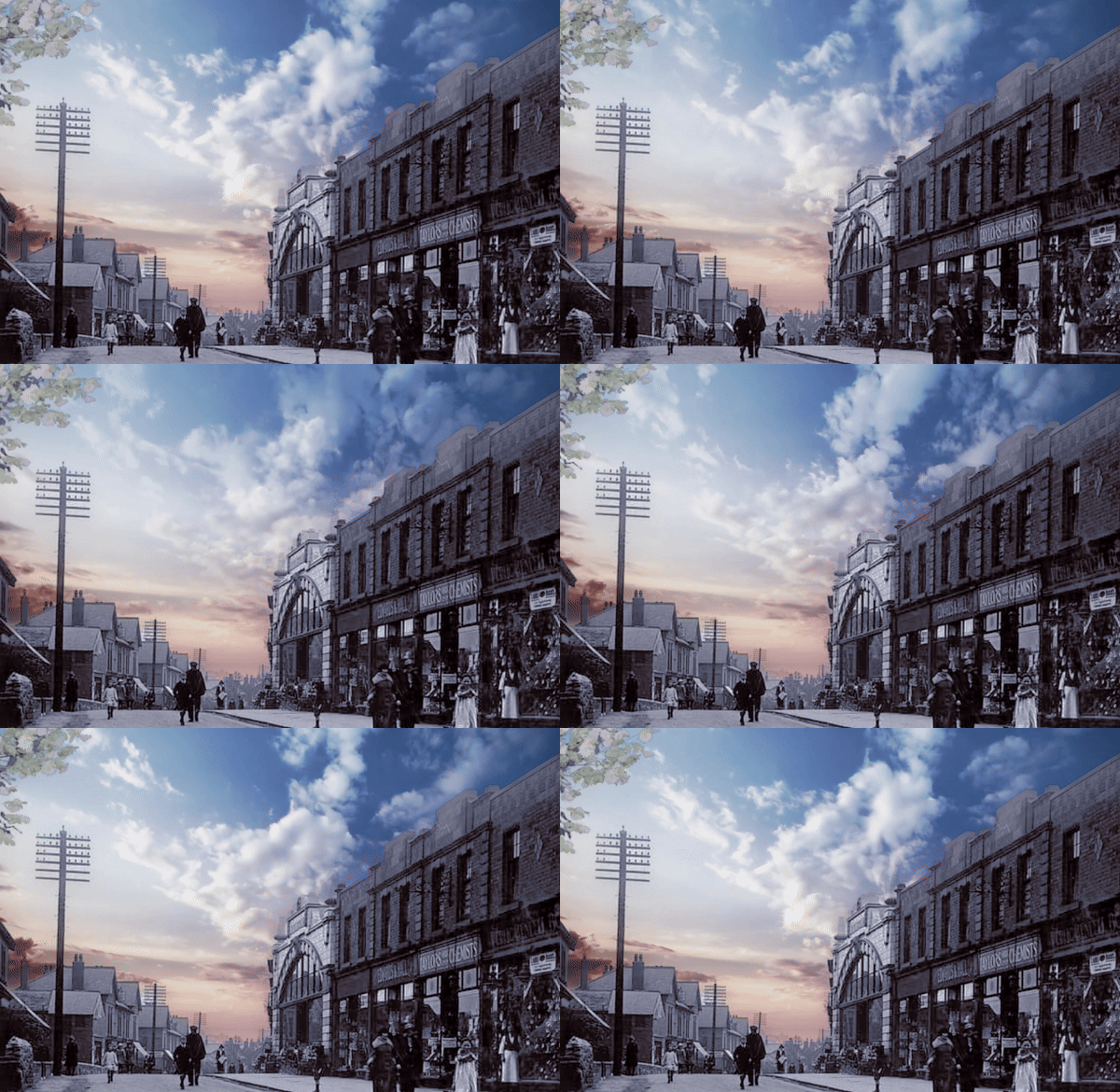
South Elmsall then fell into being a forgotten sleepy agricultural village, with buildings constructed primarily of locally sourced limestone and the land used to grow food. The earliest Ordnance Survey maps of 1840 showed that agriculture and limekilns were the main features of the village. Railways finally reached South Elmsall in 1866, when South Elmsall Railway Station was opened. Nearby Frickley station opened in 1879 and finally Moorhouse and South Elmsall Halt station in 1902. The turn of the century saw the Carlton Main Colliery Company accelerate the development of South Elmsall into the modern industrial era, with the sinking of Frickley and South Elmsall Colliery, beginning in 1903. In ‘Scars and Strikes’ Steve Coy noted that in 1903 an ash tree was taken from the Frickley Estate, from an area cleared to make way for the sinking of number one shaft, and ceremonially planted in the garden of Master Sinker, Thomas Gough, at the recently constructed terraced house row, Park Terrace. The 1911 census confirms that Thomas Gough and his family lived at number 10, sadly the tree no longer survives in the garden, but this marked the start of the rapid expansion of South Elmsall. The Carlton Main company were a model employer and undertook a wide range of projects to improve the lives of the vast incoming workforce, arriving from outside the area. Red brick buildings became the norm, with terraced houses, recreational facilities and shops quickly transforming the look and feel of the settlement. Along with this transformation came political change, with South Elmsall once again becoming a focus of national political unrest. In 1910, at the consecration of the new St. Mary’s Church in South Elmsall, and again in 1911 there were largescale Kensit protests against “the betrayal of Protestantism in the Church of England by ritualistic priests.” These protests captured the attention of national and regional press. Catholicism though was a key part of the identity of the area, as was support for Irish nationalism, with Sinn Fein having sent delegates to the area to raise support for their cause. Socialism, communism and the rights of women were also important to locals, with Labour leader George Lansbury and other leading suffragettes and political figures visiting the area at other times, all making use of the facilities created by the Carlton Main Colliery Company and their workforce. In 1934 the passing of Gabriel Price MP shocked the area, he had been a coal miner at Frickley Colliery before becoming a politician. It should come as no surprise then that local collieries such as Frickley were home to some of the most dedicated and militant striking miners and their families, during the coal miner’s strike of 1984/85.
Since the closure of the local collieries South Elmsall entered into a spiral of decline, which has been valiantly attempted to be offset by the introduction of new industries, though the transition from coal mining to warehouse distribution and warehouse manufacturing had begun years before the closure of Frickley Colliery. A prime example of this was the arrival of nationally known Standard Fireworks, who set up operations in the area post World War Two. In truth though the loss of coal mining caused seemingly irreparable damage to the fabric of South Elmsall and it’s residents, in the grand scheme of the history of the village it will eventually become an important footnote. The future is unwritten, but there can be no doubt that South Elmsall will once again be at the centre of events nationally, after all, it has a habit of doing so.

 The Story of South Elmsall