
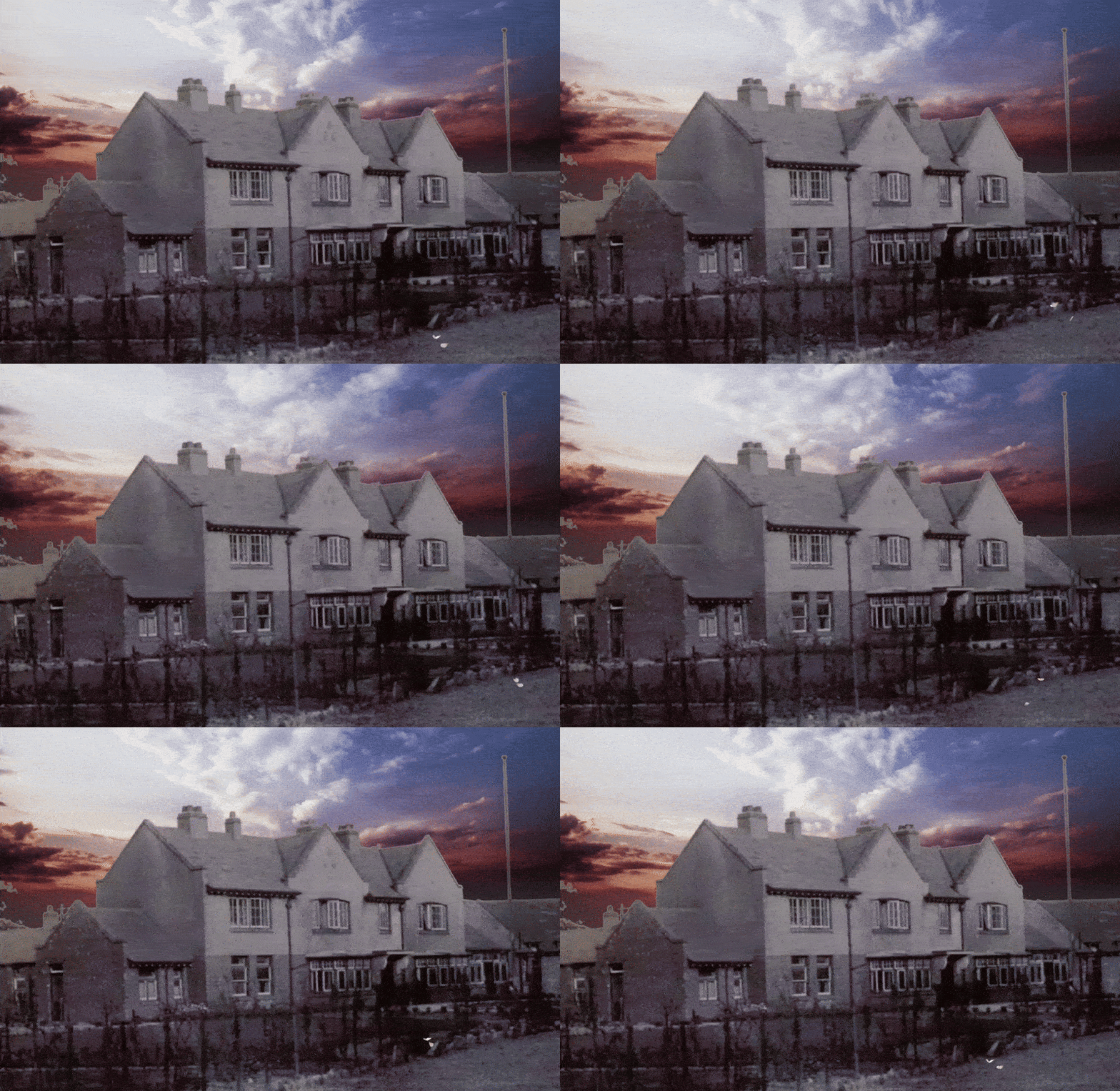
The Frickley and South Elmsall Cottage Hospital, also known as Warde-Aldam Cottage Hospital or simply Warde-Aldam Hospital, was officially opened on the 14th of November 1911, by Julia Warde-Aldam. The Sheffield Daily Telegraph of Tuesday the 14th of November 1911 reported that the hospital cost £6,000 to build, with £1,000 of that being donated, along with the land on which the hospital sat, by William Wright Warde-Aldam. The Warde-Aldam family, for readers unaccustomed to the name, were benefactors of many local projects, with the aim to support residents of villages surrounding their vast local estates. Julia Warde was the daughter of Reverend William Warde, from whom she inherited Hooton Pagnell Hall. In 1878 she married William Wright Aldam, son of Leeds Member of Parliament William Aldam, of Frickley Hall. On marriage the two combined households became known as the Warde-Aldam family, and vastly increased their wealth with the sinking of Frickley Colliery, in the grounds of Frickley Hall. The pair generously gave lands and financial support to many South Elmsall and Moorthorpe social initiatives. The Frickley Colliery Company provided the remaining £5,000 balance of the building costs. The Sheffield Daily Telegraph of Wednesday the 15th of November 1911 reported on the opening of the hospital in curious fashion. The reporter noted that no press had been invited to the event, and on arrival at the hospital reporters were told that the local police were under instruction to deny them entry to the site. The press, though angered by being denied the opportunity to inspect hospital, were impressed by the 20 bed capacity and the villa on site for the Surgeon.
Contrary to popular local belief not all miners at Frickley Colliery were happy with the levy on their wages towards the running of the hospital. The South Yorkshire Times and Mexborough & Swinton Times of Saturday 25th of May 1912 reported a heated meeting held at the Picture Palace in Moorthorpe, chaired by Gabriel Price, into this very matter. Following a recent strike by the workforce the colliery had made clear that they would not employ any men who refused to accept the levy on their salary. In response the workers demanded to choose the Surgeon who would take up residency. The meeting concluded with the agreement that the workers would pay a 6d. per month contribution, if they were given the power to choose their own Surgeon. The athletic coal miners were soon thankful for their new hospital though, as it became a common occurrence for those representing the colliery in sports, and their opposing players, to be requiring treatment. Sheffield Daily Telegraph of Monday the 15th of June 1914 reported that a Rotherham Town cricketer, Mr A. Ferguson, had been rushed to the hospital after falling and splitting his right kneecap, whist batting. So bad was the injury that play was not resumed, even after he had been taken from the field.
The Yorkshire Evening News of Tuesday the 14th of July 1914 carried a very sad tale, regarding the attempted suicide of a local miner, Mr J. Marshall. Mr Marshall had been discharged from Warde-Aldam Hospital recently, having shot himself with a revolver, in May, and having promised to never attempt to harm himself again. Mr Marshall, of South Elmsall, was said to have been unhappily married and his wife was “now living in circumstances he did not approve of”. The Yorkshire Evening Post of Saturday the 26th of June 1915 reported on a grim attempted murder, in Moorthorpe, by an army soldier home on leave. Louis Thorley, private in the King’s Own Yorkshire Light Infantry, home in Moorthorpe from his barracks, in Hull, had arrived back to his home to find his wife and her friend, Elizabeth Ryalls, engaged in conversation with a local miner, James Shaw, of Cambridge Street. Elizabeth Ryalls gave evidence that Louis Thorley had entered the lounge with a razor blade in his hand, and proceeded to cut the throat of James Shaw. Two weeks prior the two men had gotten into an altercation at the same premises, whereby James Shaw had “admitted an allegation” made by Louis Thorley. James Shaw was taken to Warde-Aldham Hospital and Louis Thorley was detained, to stand trial.
A new maternity unit proposal was reported in the South Yorkshire Times and Mexborough & Swinton Times of Saturday the 20th of September 1919. The current nurses home, located at Dunsil Cottages in South Elmsall, had been completed six years prior and had been a great success, but the new maternity unit, to be built between the nurses home and the hospital, would provide six beds and the land was again donated by the Warde-Aldam family. The South Elmsall and Moorthorpe Nursing Association, affiliated with the Queen’s Institute, had been commended for the work of it’s Secretary, Mrs Robinson, and of Nurse Lowe. The Sheffield Independent of Wednesday 15th of December 1920 noted that it was not a happy Christmas for the Danks family, of Ivy Cottages. Charles Danks, a schoolboy, had foolishly been trying to empty a detonator of it’s explosive and inadvertently blew off three fingers and his thumb, from his left hand. He was taken to the hospital for care. In April 1921 there were presentations made to Nurse D. Lowe and Nurse J. Whalley, in recognition of their work with the South Elmsall and Moorthorpe Child Welfare Association. The pair were given gold watches, as noted in the Sheffield Daily Telegraph of Saturday 16th April 1921. Both were set to leave the area to take up new positions in Widnes.
The Leeds Mercury of Monday the 5th of September 1921 reported into the tragic death of Tom Davis, at Warde-Aldham Hospital. Tom Davis was a miner from Moorthorpe who had had his leg amputated, around eleven years prior, ran up a bank whilst riding his motorcycle on a narrow lane, and fell under the lorry of Thomas Handley, of Doncaster. The passenger in the sidecar, George Carlisle, was not seriously injured. The Sheffield Daily Telegraph reported on Monday 9th of January 1922 that Samuel Turton had been arrested for attacking a fellow miner at Frickley Colliery. The article noted that Samuel Turton had accused his colleague, Benjamin Barlow of South Kirkby, of downing tools ten minutes before the end of his shift. Samuel Turton then allegedly hit Benjamin Barlow around the head with a bottle, which required treatment at the hospital.
The horrific death of a 10 year old girl at Warde-Aldam Hospital was reported in the Sheffield Daily Telegraph, on Wednesday 11th of January 1922. Olive Needham, of 35 King Street, South Elmsall, had been asked to put the kettle on, by her stepmother who was upstairs, and somehow in the process caught her clothes alight. Mrs Needham noted that upon hearing the little girl scream, she ran downstairs and saw the girl on fire, and used water to extinguish the flames. Olive Needham died of her injuries in hospital. An inquest was held by District Coroner Major W. B. Arundel into the death of 30 year old Thomas Joseph Ashby, as reported on the 14th of January 1922 in the Sheffield Daily Telegraph. The inquest found that Thomas Ashby, a miner from 164 Harrow Street, Moorthorpe, died as a result of accidental death, following a roof fall at Frickley Colliery. Witnesses said that Thomas Ashby was crushed by a two ton block of coal, and Dr Claude Pyecroft, of Warde-Aldam Hospital, noted that he had a broken leg and a large puncture wound likely to have been caused by falling on his own pick.
On Monday the 20th of March 1922 it was noted in the Sheffield Independent that 24 year old Harold Ogley, who had lost an arm in the First World War, accidentally ran into a dog as he cycled down the steep High Street in South Elmsall. After being thrown from the bicycle he was found to be in a critical condition, on arrival at the hospital. An inquest into the death of Albert Swift, aged 56, of Faith Street in South Kirkby, was held by the District Coroner, Major Arundel, as reported in the Sheffield Daily Telegraph of Wednesday the 19th of April 1922. It was outlined that Albert Swift had visited the Soldiers and Sailors’ Club, on April the 1st, and fallen down the stairs, and died in Warde-Aldam Hospital two weeks later, having never regained consciousness. Albert Swift’s lodger, George Giles, gave evidence that when Albert Swift had arrived home George Giles assumed he was drunk, and left him to sleep on the sofa. When he found him lifeless the next morning he alerted the hospital. A verdict of accidental death was reached.
The Sheffield Daily Telegraph of Wednesday the 7th of May 1924 reported on a serious accident that had occurred, at Barnsdale Bar, when two South Elmsall residents collided with a wall, whilst riding a motorcycle. Mr J. Weldin, a colliery clerk, was the driver of the motorcycle and his sidecar passenger was Mr E. J. Fletchett. Upon colliding with the wall Mr Fletchett was thrown over the remains of the wall and the pair were knocked unconscious. After an hour or so Mr Fletchett regained consciousness and flagged down another motorist, and the pair were taken to Warde-Aldam Hospital. At the time of publication Mr Weldin had not regained consciousness. Some other local publications name the pair alternatively as Weldon and Fritchett. On the 18th of August 1924 the Leeds Mercury gave an overview of the court proceedings against William Wildman and Joseph Hodgkiss, both of South Elmsall, following their antics underground at Frickley Colliery. It was alleged that at the end of their shift the pair dangerously raced their ponies along the underground workings, endangering lives. One man, who was desperately waving his lamp to try to get them to stop was knocked down and was taken to the hospital with a fractured skull and broken ribs. Both men were found guilty and sentenced to hard labour.
The Sheffield Daily Telegraph noted on Wednesday 5th of August 1925 that over 1,000 injuries from accidents at Frickley Colliery had been attended to by the hospital, in the year prior. The South Yorkshire Times and Mexborough & Swinton Times of Friday the 20th of July 1928 reported that George Clark, an employee of Mr Roper of Clayton, had injured himself whilst loading hay, and was taken to the hospital with a fractured collarbone, and was said to be in a serious condition. The Sheffield Independent of Friday the 28th of December 1928 carried a short article noting that Mr G. Utley, the left back of Moorthorpe Rangers, had broken his leg during their Doncaster Red Triangle League fixture versus Brodsworth St. Michael’s. So severe was the break, that the referee stopped play until Mr Utley was taken to Warde-Aldam Hospital for treatment. On Wednesday the 28th of August 1929 the Yorkshire Post and Leeds Intelligencer reported a curious incident, when South Elmsall’s Police Constable Robertshaw was taken to Warde-Aldam Hosital, after being injured in an accident with a car owned by none other than the local doctor. Mr Robertshaw was riding his motorcycle up High Street when Dr H. N. Norton’s car, driven by his wife, collided with the motorcycle, Mr Robertshaw suffered head injuries.
Not everything was doom and gloom though, at the hospital. The South Yorkshire Times and Mexborough & Swinton Times of Friday the 3rd of January 1930 noted that patients at the hospital were entertained by the Glad Rag Syncopators, a troop made up of Mr L. Harper, Mr R. Wright, Mr T. Black, Mr H. Leadbeater, Mr C. Wood and Mr N. Tyrrell. The Spencer Twins were also on the programme. On Friday the 5th of December 1930 the same publication reported on another packed entertainment programme delivered at the hospital, arranged by Mr W. Thornton and Mr W. Harrison. The concert saw performances by Miss W. Lawrence, Mr J. Rowbottom, Mr D. Jones, Mr S. Wells, Mr A. Jones, Mr J. Nightingale and Mr T. Page. Meanwhile Dr Claude Pyecroft, of Warde-Aldam Hospital, was busy himself producing a performance of A Doll’s House, with his South Elmsall Arts Fellowship. This was the fourth play performed by his society, in South Elmsall.
The Hull Daily Mail reported on Tuesday the 28th of July 1931 that a coal miner from Frickley Colliery had been taken to Warde-Aldam Hospital, following a roof fall. Joseph Baker, aged just fourteen, was working on the Barnsley seam when the incident occurred, and his thigh was broken. Joseph lived on Carlton Street. It was a busy 24 hours for the staff at the hospital, the Leeds Mercury of Tuesday 28th of July 1931 reported on a remarkable escape by motorists involved in a serious collision at Upton. A car driven by John Oldham, of Bradford, collided with a bus driven by Leslie Sutton of Barnsley Road, Moorthorpe. The bus, which was “reduced to matchwood”, was empty of passengers, but the car was carrying passengers. Both vehicles were overturned and the drivers thrown from them. Miraculously only John Oldham was injured, and he was taken to Warde-Aldam Hospital for treatment. Another local footballer was badly injured in August of 1931, when South Elmsall’s Leslie Fisher, playing left half for Oxford Juniors, broke his right leg during the game and was taken to the hospital, as reported by the Leeds Mercury on Friday the 21st of August 1931. On Monday the 19th of October 1931 the Hull Daily Mail noted that Frickley Colliery’s inside left, Stanyon, broke his ankle in their Football Association Cup tie versus Yorkshire Amateurs. Again he was taken to Warde-Aldam Hospital.
Warde-Aldam Hospital’s Doctor Claude Pyecroft was called on to deliver evidence at the inquest into the death of Joseph McCroakham, reported in the Leeds Mercury of Thursday 29th of October 1931. Joseph McCroakham, a 65 year old of Carlton Road, South Elmsall, was found barely alive on the railway line between near Moorthorpe, where he had laid for around twelve hours, on a frosty night. After being found and taken to Warde-Aldam Hospital Joseph McCroakham told Dr Pyecroft that he had missed his stop at Moorthorpe and instead got off at the next stop and decided to foolishly walk along the tracks, where he was struck by a train. He passed away at the hospital later, a verdict of death by misadventure was decided upon.
Christmas at the hospital that year proved to be a grim affair, when staff were called upon to deal with a colliery disaster that shook the village, and claimed a number of lives. On the 28th of December 1931 five Deputies of the colliery were making their inspections, following the Christmas closedown, and were fatally gassed. The Nottingham Evening Post of the 28th of December 1931 noted that seven Deputies had entered the pit, and around 5am five of them were suddenly overcome by carbon monoxide. Two Deputies managed to make it to the surface but five of them sadly died. The Leeds Mercury gave a full account of the tragedy on Tuesday 29th of December 1931. It noted that the dead Deputies were Thomas Howarth, James Parsons and William Evans of Broad Lane, James Pickup of Common Road, South Kirkby and Joseph Kitching of North Avenue, South Elmsall. The five Frickley Colliery workers who were killed were buried at Moorthorpe Cemetery, as reported by the Leeds Mercury on Wednesday the 30th of December 1931. Some of the survivors of the disaster included Fred Boulton of Broad Lane, Joseph Simpson of Minsthorpe Lane, and George Charlesworth of Broad Lane, who were all recovering from the effects of gas, at Warde-Aldam Hospital. The United Kingdom Coal Mining Accidents and Deaths Index, 1878-1951 tells us the five men killed were 43 year old James Parsons, 43 year old Thomas Howarth, 52 year old Joseph Kitching, 49 year old William Evans and 45 year old James Pickup. A little while later, as reported in the Coventry Evening Telegraph of the 30th of December 1931, whilst working to seal up the areas affected by gas, Harry Stevens, a 41 year old from Springfield Mount in South Kirkby, was himself overcome and sent to the hospital, but was quickly passed fit to go home.
The death of long serving Matron of the hospital was reported in the Sunderland Daily Echo and Shipping Gazette on Tuesday the 12th of January 1932. Miss Annie Eliza Howard was employed as the very first Matron at the hospital, from it’s opening in 1911, and was revered locally as “Florance Nightingale the Second”. In her long and illustrious career in nursing Miss Howard served in both the Boer War, at Khartoum, and on the hospital ship Asturias, in the First World War. The Asturias began life as RMS Asturias, a Royal Mail Steam Packet Company liner, before being requisitioned as a hospital ship, becoming HMHS Asturias, on the eve of war. The Asturias and her crew were sent to Le Havre, in France, where they treated wounded troops from the British Expeditionary Force. The crew also took part in the Gallipoli Campaign, in Turkey, and on one occasion were commended for recovering over 2,400 sick and wounded back to Britain. On the 1st of February 1915 a German U-boat fired a torpedo at the Asturias, which struck the vessel but miraculously failed to detonate. In early 1916 King George V paid a visit to Asturias, raising morale of the crew and patients. In October 1916 the regiment of J. R. R. Tolkien made an attack on Regina Trench, in the Battle of the Somme. In November J. R. R. Tolkien was invalided back to Britain aboard the Asturias. On the night of the 20th of March 1917 the Asturias was again torpedoed by a German U-boat, miraculously having disembarked over 1,000 wounded that day in Avonmouth. The crew, including 50 nurses, were ordered to abandon ship, reports vary on fatalities, but one counted 35 dead crew. On Saturday 16th of April 1932 the replacement Matron was chosen, from over 300 applicants, as reported by the Sheffield Independent. The new Matron was Miss Toye, who had been Assistant Matron at Aberdare Hospital in South Wales, for eleven years.
The Yorkshire Post and Leeds Intelligencer reported briefly on Monday the 20th of February 1933 that another local footballer had been taken to Warde-Aldam hospital with a broken leg, this time the unlucky athlete was Harry Gill, who fractured his left leg in the first minute of a South Kirkby League game. In July that year eighteen month old girl Elsie Flavell, of Carlton Street, was rushed to the hospital in a serious condition, as reported by the Huddersfield Daily Examiner on Friday the 7th of July 1933. Young Elsie had been hit by a van, whilst playing in the street, and suffered crushed ribs. The Yorkshire Post and Leeds Intelligencer announced on Wednesday 28th of November 1934 that twenty-six year old Alvin Hyde, a coal miner of 11 York Street, Hemsworth, had died at the hospital. Alvin Hyde and five other men had been walking on the road in Upton, when he was struck by a car. The approaching new year brought better news, when the Sheffield Independent reported on Saturday the 1st of December 1934 that the hospital was to benefit from a “windfall” from the Miner’s Welfare Fund, to push ahead with a £3,313 scheme to improve facilities and build an extension. This included building a new wing, a massage facility, purchasing x-ray and other medical equipment and improving the operating theatre.
The Halifax Evening Courier reported, on Tuesday the 14th of April 1936, that Ernest England, the former Sunderland left back, was rushed to the hospital with concussion, after heading the ball, in a game for Frickley Colliery, versus Scarborough. During the game he recovered without needing treatment, but after full time he collapsed in the dressing room, and was still only semi-conscious at the hospital, he could not even remember playing the last 20 minutes of the game. The Monday 20th of April 1936 Hartlepool Northern Daily Mail noted that he had been discharged from the hospital on the 19th of April.
Another serious accident occurred at Frickley Colliery in October of 1936, the Dundee Evening Telegraph of Thursday the 15th of October 1936 reported on the incident. Towards the end of their shift, around five in the morning, a number of men were buried and trapped by a roof fall. One man, 25 year old Alfred Thomson, of Cambridge Street in Moorthorpe, who was buried up to his waist, was quickly rescued, but three further miners remained trapped, at the time of the publication. 25 year old Leaonard Mills, a married miner who lived on Willow Street in South Elmsall was one. Another of the unlucky miners was Mark Danks, a 39 year old from Whitmore Street, in South Elmsall and the final miner was 35 year old Dennis Arthur Bassindale, of North Avenue, South Elmsall. Alfred Thomson was taken to Warde-Aldam hospital and was said to be comfortable. The Manager of Carlton Main Colliery Company, Mr W. H. Tagg, along with Sidney Gill, a Director of the company, accompanied the rescue team. The Scotsman gave an update, on Friday the 16th of October 1936, noting that “after a day of continuous striving to reach the men all hope of saving them was abandoned late last night. To secure the maximum results, rescue workers operated in half hour relays, but their efforts were impeded by frequent falls of roof and they were constantly in danger.” The Leeds Mercury of Friday 16th of October 1936 gave us more details. The roof fall was reported by them to have been seven yards high by thirteen yards long, and weighing hundreds of tons. The incident happened on number 19’s conveyor unit, on the east district of the Barnsley seam, as the men were leaving at the end of their shift. One eyewitness, Joseph Miles of 10 North Avenue, told the paper that he had been behind the men when the fall occurred and he helped to liberate Alfred Thomson, who was freed after two hours. Fred Finney, of Oxford Street, South Elmsall and Jack Davies of Doncaster Road, South Elmsall, noted that they “ran for it” to avoid the fall. The full address of Dennis Bassindale was given as 29 North Avenue. Leonard Mills’ full name was provided, as Leonard Charles Mills. Mark Danks’ full address was provided, being 2 Whitmore Street. It was also reported that all the men were in fact married, Mark Danks had five children, Bassindale was a father of three children and Mills had one child. Leonard Mills, who had formerly worked at Upton Colliery, had only been working at the pit for three weeks. The Leeds Mercury noted on Wednesday the 21st of October 1936 that Leonard Mills had been allowed to leave hospital.
The Bradford Observer of Thursday 29th of October 1936 ran a rather strange report, on the curious case of South Elmsall coal miner, Walter Petch, who was found with a broken leg, broken arm and fractured ribs, on the platform of South Elmsall railway station. It was thought that he had been blown down in a gale, but due to concussion he was not able to offer any insight into his mysterious injuries, when being cared for at Warde-Aldam Hospital. Things were a tad more joyous in January 1937, with the marriage of Frederick Hemsley, the Surgeon at Warde-Aldam Hospital being announced in the Leeds Mercury of Wednesday 6th of January 1937. His bride was Margot Crosthwaite, and they were wed at St. Wilfred’s Church, in Harrogate. Friday the 18th of June’s Leeds Mercury reported that another concussed man, Isiah Hale aged 24, from Streethouse, was found at the foot of Hague Hall hill in South Kirkby. The cyclist was unable to account for his accident, due to memory loss, and was taken to Warde-Aldam Hospital for treatment.
The hospital was so much in demand that it had outgrown it’s capacity again, by 1937, and the Sheffield Independent of Thursday 19th of August 1937 reported that both the women and children’s ward needed an extension, to increase it’s capacity to eighteen beds, from just six. Dr Hemsley said that “attention should be drawn to the inadequate accommodation for female and child patients, for whom only six beds are available, thereby necessitating delay in admission into hospital”. The annual report showed that the hospital had an income of £4,247 and 18 shillings, against an expenditure of £4,220 and 2 shillings. The Carlton Main Colliery Company directly provided £2,150 of the income, and the working men at Frickley Colliery gave £1,684 and 8 shillings towards it’s upkeep. That year 2,315 treatments were provided to the public, with 891 of them being colliery accidents.
On Friday the 5th of November 1937 the South Yorkshire Times and Mexborough & Swinton Times reported that the campaign to raise £3000 in funds to extend the hospital were underway, with £740 and 14 shillings being in the pot, so far. Some notable contributors to the fund included John Ralph Patentius Warde-Aldam of Frickley Hall (who had inherited Frickley Hall from his parents), E. V. Fox and Sons of South Elmsall, Mr and Mrs Greenwood of South Elmsall, Mr and Mrs Mozley of South Elmsall, Mr and Mrs Clough of South Kirkby, Mr Harvey of South Elmsall and Mr and Mrs Palmer of South Elmsall. On Friday the 24th of December 1937 an update on the appeal was provided in the Penistone, Stocksbridge and Hoyland Express, which had reached £1274, 12 shillings and 8d raised. New notable local contributors included the Wesley Guild of South Elmsall (arranged by Miss Thompson) and John Hodson of Moorthorpe. Also on Friday the 5th of November 1937, the Bradford Observer reported that another cyclist had got themselves into mischief, and been taken to the hospital for care. Roland Williams, aged 20 and of Thursncoe, had been riding his bicycle from his workplace in a chemist’s shop in South Elmsall, when he fell from his cycle at the foot of Elmsall Hill (High Street), and lacerated his scalp. Leeds Mercury reported on Monday the 6th of December 1937 that another serious road accident had occurred in Upton, with one of the injured being the well known footballer and cricketer, Willis Walker. Having begun his sporting career with Sheffield United (both for football and cricket), Willis Walker went on to play professional football as a goalkeeper with Doncaster Rovers, Leeds City, South Shields and Bradford Park Avenue, in both the Football League and Football Association Cup. He combined his football with cricket throughout his life, and played first class cricket for Nottinghamshire as a batsman. Towards the end of his career Willis Walker opened up a chain of successful sporting goods stores, from his base in Keighley. The car being driven by Willis Walker was collided with by that of South Elmsall man Peter Mitchell Wilson, who was en-route to Upton. On man involved was taken to Ward-Aldam Hospital with minor injuries.
The Belfast Telegraph of Wednesday 29th of December 1937 reported on another grim Christmas in South Elmsall, following the death of John William Turner, at Frickley Colliery. John Turner, a 34 year old fitter of Albany Street in South Elmsall lost his life, and six others had to receive hospital treatment for the effects of fumes, as a result of an underground fire. John Turner was married and had three children. The men who received treatment at Warde-Aldam Hospital included the South Elmsall men John Platt, aged 37, Albert Ellis aged 41, Percy Perks aged 37 and John Hill aged 38. George Walker aged 38 of Upton and George Donaldson, of Moorthorpe were also taken to hospital for treatment. The report noted that John Platt and John Turner were engaged on repair work when they were met by fumes from a fire two miles from the pit bottom and Turner was quickly overcome by fumes. John Platt tried to drag John Turner to safety, but was losing his senses in the suffocating smoke and had to leave him behind, to reach safety and sound the alarm, to save other lives. Rescue workers wearing respirators recovered John Turner’s lifeless body and attempted artificial respiration for 75 minutes without success. Messages were flashed on the screen at the local cinemas, such as The Empire, calling for all rescue workers to go to the colliery at once. The Birmingham Daily Gazette of Wednesday the 29th of December 1937 added further information in their report, noting that John Platt lived at Frickley Villas in South Emsall, Albert Ellis lived on Eric Street, South Elmsall, Percy Perks was of Queen Street in South Elmsall, George Walker was from Clayton Avenue in Upton, John Hill was of New Valley Street in South Elmsall and George Donaldson lived on Harrow Street, Moorthorpe.
Another cyclist was injured in a collision with a lorry, which failed to stop. while cycling on the main Doncaster to Wakefield road in Upton, as reported by the Yorkshire Evening Post on Monday 10th of January 1938. Frank Haigh, a bricklayer from Hemsworth was admitted to Warde-Aldam Hospital suffering from severe head injuries. The Yorkshire Post and Leeds Intelligencer of Monday the 10th of January 1938 gave further information, in that Frank Haigh was in a critical condition and that the lorry was red. Police were seeking the driver. Another road collision was reported by the Leeds Mercury on the 9th of March 1938, when two buses collided between South Elmsall and Upton. It was noted that visibility was only three yards and the buses collided head on. Gladys Waugh of Brampton Bierlow, a conductress on one of the buses, sustained a lacerated wound on the forehead. George Gott, aged 34 of Cross Street in Upton, suffered a cut lip. Both went home after treatment at the hospital. In June 1938 another incident involving a local bus saw Marina Simpson, aged three, of Frickley View taken to hospital. The Bradford Observer of Tuesday the 21st of June 1938 reported that the young girl had fractured her thigh when she was knocked down by a bus near her home.
On Wednesday 24th of August 1938 the Leeds Mercury reported that another cyclist was badly injured, this time being a young Frickley Colliery Haulage Hand, Richard Skidmore, aged 18, who was cycling from work at Frickley Colliery to his home on Camp Road in South Kirkby, collided with a lorry on Stockingate. His right leg was broken and he was taken to Warde-Aldam Hospital. The Sheffield Independent noted in their Monday the 29th of August 1938 edition that a verdict of death by misadventure’ was returned at inquest into the death of Wilfred Andrew of First Avenue, South Kirkby. Wilfred Andrew, aged 23, was fatally injured in the Barnsley seam at Frickley Colliery whilst shovelling a heap of dirt, when he was buried by fall of stone. His back was broken and he sadly died two hours after being admitted into Warde-Aldam Hospital. In brighter news the Leeds Mercury reported on Wednesday the 14th of September 1938 the remarkable escape from serious injury at Frickley Colliery yesterday, of a coal miner from South Kirkby. William Smith, aged 48 and of Dunsley Terrace, South Kirkby was hit by a piece of coal weighing about two tons then was pinned against a coal cutting machine by the lump, which took fifteen men a quarter of an hour to prise away with iron bars. He was taken to the hospital to be given the once over, apparently unscathed.
Another footballer made the headlines for requiring treatment at Warde-Aldham Hospital in March 1939. The Sheffield Daily Telegraph of Monday 6th of March 1939 reported that an 18 year old debutant, broke his right ankle, in a game against Peterborough United. The Frickley Colliery outside left, Langford, was removed from the football field at Westfield Lane, with 20 minutes remaining, in a heavy 0-3 loss. The Leeds Mercury of Friday 24th of March 1939 noted yet another miraculous escape by a Frickley Colliery worker, when 18 year old Carl Spencer, of Harrow Street in Moorthorpe, was pinned by part of a roof fall weighing an estimated 50 tons. Carl Spencer was buried up to his neck, but somehow his head remained free. Heroic rescuers freed him, and he was taken to Warde-Aldam Hospital and said to have been “cheery”. The incident occurred when a runaway set of tubs crashed into a support, bringing down the roof, Carl Spencer survived by quickly jumping into a refuge cut into the coal, and he remained calm throughout the ordeal, and was commended for his bravery. His father kept vigil for five hours at the pit surface, during the rescue.
In August 1939 it was announced that the appeal to raise funds to extend the hospital, which had begun two years prior, had been successful, though the Leeds Mercury of Friday 18th of August 1939 noted that the appeal for £3,000 was to remain open, as costs had risen by £200. The Bradford Observer on Tuesday 15th of October 1940 noted yet another serious road collision. This time a lorry driven by Raymond Glynn of Dewsbury collied with a car driven by John Bird Glover of Shipley, in South Elmsall. The occupants of the overturned lorry clambered to safety through the windows, John Glover was less lucky, and was taken to Warde-Aldham Hospital for treatment. A married miner from Upton was killed in another incident at Frickley Colliery, in January of 1943. The Bradford Observer reported on the 22nd of January 1943 that William H. Brown, of Strickland Road in Upton, died from his injuries, at the hospital. William Brown was 30 years of age and had five children. The Yorkshire Post and Leeds Intelligencer on Friday 22nd of January 1943 added further information, the incident was another roof fall.
The Yorkshire Post and Leeds Intelligencer reported on Wednesday the 4th of August 1943 that a cyclist was injured at the Frickley Colliery Athletic Club sports event in South Elmsall. H. W. Clarke ran into another fallen cyclist, and was thrown from his own cycle, injuring his arm and leg, requiring attention at the hospital. Yorkshire Post and Leeds Intelligencer of Wednesday 22nd of September 1943 noted that another fire had broken out at Frickley Colliery, but all was in hand. Clifford Riley, Superintendent of the Carlton Main Colliery Company’s rescue station in Brierley had been overcome by smoke, but after a once over at Warde-Aldam Hospital he was sent home. The Derbyshire Times reported on Friday the 8th of September 1944 that Lieutenant A. Walters had been promoted to the rank of Captain, having initially joined up as a volunteer, at the rank of Private. Captain Walters was the husband of a nurse at Warde-Aldam Hospital. Two more miners at Frickley Colliery were injured in 1949, as reported by the Bradford Observer on Monday 17th of January 1949. Joshua Howcroft and Walter Dodson had been ripping the roof in the Barnsley seam, atop a 16ft high scaffold, when a fall of coal occurred. Joshua Howcroft, aged 40 and of Faith Street in South Kirkby, was seriously injured and taken to Pinderfields Hospital in Wakefield. Walter Dodson, aged 35 and from Park Estate in South Kirkby, was less badly hurt, and taken to Warde-Aldam Hospital. The year continued to be a challenging one for Frickley Colliery, as noted in the Yorkshire Post and Leeds Intelligencer of Wednesday 29th of June 1949. Six miners were injured following collision of trains underground, when a locomotive pulling men at the end of their shift from the coal face to the pit bottom slid back down into a stationary train behind it. At the time of the publication John Gibbons, aged 45 and of Cudworth was being treated for internal bruising and a damaged hip, Arthur Winters, aged 68 and of Queen Street in South Elmsall was in hospital with a back injury and Cecil Hepworth, aged 51 and from Park Estate in South Kirkby was been assessed for a head injury. Staff at Warde-Aldam Hospital had allowed James Galvin, aged 51 and of Valley Street, South Elmsall to return home, with a slight scalp wound and damaged fingers. Similarly William Harby, aged 59 and of Broad Lane, South Kirkby, had been discharged after treatment for injuries to his ankle and knee, along with George Cross of South Elmsall, who had a sprained thumb.
Sixty-two year old John Wood, of Albion Place in South Elmsall was given treatment for an injured knee, at the hospital, as reported by the Bradford Observer of Wednesday 2nd of August 1950. The incident occurred when his horse he was in charge of bolted and crashed through a barbed wire fence, in South Kirkby, the horse was seriously injured. The Yorkshire Post and Leeds Intelligencer, in it’s comprehensive coverage of bonfire night injuries, published on Monday the 6th of November 1950, included the sad case of Charles Wooffenden, an 11 year old boy from South Kirkby who was struck by a firework in the eye, and rushed to Warde-Aldam Hospital. The Bradford Observer of Saturday the 2nd of February 1952 covered the inquest into the sudden death of Warde-Aldam’s resident doctor, Dr Diana Pamela Sylvester Cargill. Dr Cargill had been informed that her position at the hospital was not to be renewed, and she had become depressed, and begun taking sedatives to help her sleep. Her husband claimed that she had not threatened to take her own life, and though suffering with depression she had seemed in good spirits. The Pathologist found that a high level of barbiturates were in the system of the 36 year old doctor, a dangerously high level, but her death was recorded as “death from natural causes”. Another high profile local resident passed away at the hospital in 1954, as reported in the South Yorkshire Times and Mexborough & Swinton Times of Saturday the 6th of February 1954. James Guest, aged 65, was a prominent businessman from Mexborough, where he had successfully owned a number of successful businesses and been elected to serve on the Mexborough Urban Council.
On Saturday the 23rd of June 1962 the Bexhill-on-Sea Observer reported that Claude Pycroft had been award the freedom of the Borough of Bexhill, where he was acting as an Alderman. Claude Pycroft retired to Bexhill in 1936 and was co-opted onto the Town Council in 1940 and became Mayor in 1949. The Pycroft family had emigrated to South Africa in 1894, where Claude studied until graduating from university at the University of Capetown, at which point he returned to Britain to study medicine at Edinburgh University. The Pycroft family were committed to healthcare, his father was a dentist and his sister, Gertrude, studied medicine alongside Claude in Edinburgh. Around 1913 Claude moved to South Elmsall, where he took on the role of managing Warde-Aldam Hospital, until his retirement. Whilst a South Elmsall resident Dr Pyecroft established the South Elmsall Arts Fellowship, who performed stage shows locally, and Claude was a keen musician. On Saturday the 27th of May 1967 the Bexhill-on-Sea Observer published a letter penned by a visitor to a Blackpool guest house owned by former South Elmsall resident, Mrs Tipton, regarding how Dr Pyecroft had saved the life of Mr Tipton, when he lost his leg in an accident at Frickley Colliery. Following the accident Dr Pyecroft advised the couple to being new lives by opening a guest house in Blackpool and in 1936 they did! Doctors orders! Mr and Mrs Tipton also fondly remembered two former matrons of the hospital, Matron Toye, who had been at the hospital at the time of the accident, and Sister Clarke, who had recently retired. It was also noted Claude had emigrated back to South Africa.
On Wednesday the 3rd of April 1963 the Liverpool Daily Post reported that seven Frickley Colliery miners were injured in a collision between two diesel trains in the Dunsil seam. The miners were kept in Warde-Aldam Hospital to be observed, all suffering from shock, cuts and bruises. A dozen other miners were treated for cuts at the medical centre at the colliery. The incident occurred when around 80 miners, riding on a train from the pit bottom to the coal face, collided head on with a train hauling coal in the opposite direction. On Wednesday the 8th of June 1966 the Birmingham Daily Post reported that three miners with their clothing ablaze ran through a wall of flame after an explosion at Frickley Colliery. They were Thomas Currie, aged 46, of Church Avenue in South Kirkby, John Charles Donaldson, aged 39, of Victor Street in South Elmsall and Raymond Bradley, aged 36, of King Street, South Elmsall. All three were taken to Warde-Aldam Hospital suffering from burns.
The South Yorkshire Times and Mexborough & Swinton Times reported on Saturday the 27th of November 1971 on the popular local club entertainer, Peter Bellemy, raising funds for local causes, such as kidney dialysis machines. A key element of the fundraising was the annual South Yorkshire Celebrity Club Concert, and Warde-Aldam Hospital was beneficiary of the fundraising efforts. On Friday the 22nd of April 1988 local councillor Harold Mills wrote a staunch letter, published by the South Yorkshire Times and Mexborough & Swinton Times, bemoaning the plan to approve the sale of the hospital to Anchor Housing Association, and questioning if proceeds of the sale would be invested back into South Elmsall for new casualty and hospital facilities. Councillor Mills again appealed to locals to oppose the plans put forward by Pontefract Health Authority, in the South Yorkshire Times and Mexborough & Swinton Times of Friday the 13th of May 1988. It was reported that should Warde-Aldam Hospital close, the health centre on Little Lane may become a local casualty department, a plan which Harold Mills deemed unlikely to happen, due to lack of funds needed to extend the health centre into a hospital.
The fight to save Warde-Aldam Hospital proved futile, it was closed and all hospital services were provided by larger hospitals in the more heavily populated towns and cities surrounding South Elmsall. Over the course of its lifetime as a hospital, the building played a part in many thousands of lives, with so many local residents being patients, employees and so on.


 The Story of South Elmsall