
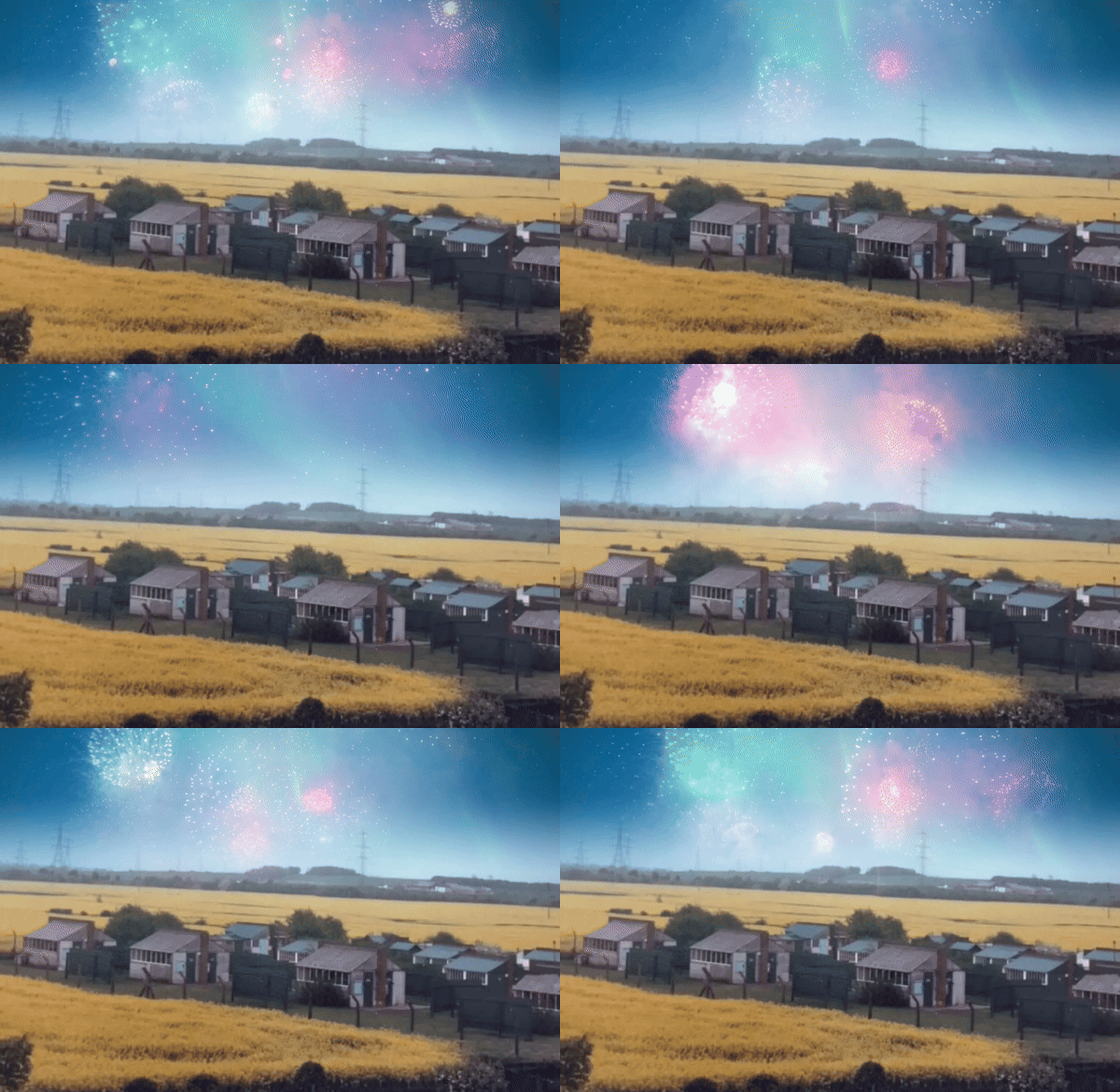
In June 1946 Huddersfield based Standard Fireworks announced their intention to set up a production facility in South Elmsall. A Huddersfield Daily Examiner article from the 7th of June noted that a fourteen acre site, encompassing three purchased fields, was to be developed into a production factory that would aim to employ 60 women. The company had chosen to expand into South Elmsall due to a lack of female labour available in Huddersfield, with 30 girls to be recruited, in the initial phase of the project. Standard Fireworks had been founded in 1891 and were a household name in firework production.
On the 18th of July the Yorkshire Evening Post announced that Standard Fireworks had been granted a licence to begin fireworks production, at a site on Common Lane (now known as Doncaster Road). By March 1947 the Yorkshire Post reported that 30 girls were now in work, in six double workshops that were separated to minimise risk, and six more workshops were due to begin construction soon. The site of the first factory was close to Goosehole Lane, off Common Lane (Doncaster Road today). A Bradford Observer article from the 18th of July 1950 noted that a second South Elmsall factory had been opened that year. By 1953 demand was outpacing production, despite both South Elmsall sites being fully staffed to capacity by local women, as reported in the Bradford Observer of 16th of June.
The site chosen for the new facility on Broad Lane was surprisingly close to Broadway, Broadway Terrace etc, on the site of allotment gardens, as can be seen on the Ordnance Survey map of 1949. On 29th of May 1959 the Huddersfield Daily Examiner reported that 150 women from both local factories had joined 450 other women employed by Standard Fireworks at other locations, to enjoy a team day out in Llandudno. All of the women wore an artificial white rose, with each factory having a unique rose design, and were provided a specially chartered train for their journey. By January 1966 the Broad Lane site was employing 70 local women, as reported in the South Yorkshire Times. On the 13th of May 1967 Standard Fireworks advertised in the South Yorkshire Times for a man to supervise at Broad Lane, the one stipulation being that they must be married! On the 20th of May they advertised there again, this time for a carrier role, but insisted this should be a 15 or 16 year old boy!
In a rather strange quirk, one such teen male employed by Standard Fireworks, 16 year old John ‘Dusty’ Miller of Valley Street, made the local press not long after this advertisement was placed, when the 26th of February 1969 South Yorkshire Times reported on the exploits of a local blues band, known as Nansen’s Fram. The unusual name was taken from an attempt by a Norwegian explorer, Fridtjof Nansen, to reach the geographical North Pole in the 1890’s. The band’s 19 year old guitarist Steve Harrop of Beech Street told reporters that “Fram means cool and progressive, and describes our blues and progressive music, which is based on the negro spiritual music when the negroes were slaves on the cotton plantations in the 19th century.” The band had somehow scraped together £1,000 to buy equipment and had recently launched their bid for stardom, at Minsthorpe Carnegie. The band was competed by 16 year old bassist Steve Crossland of Elm Estate and 18 year old drummer Martin Coukham of Victor Street. Sadly there is no indication that the band did very much after their brief flirt with fame.
The 8th of April Grimsby Daily Telegraph showed that not everything at Standard Fireworks was so light hearted, when it reported on the death of a woman working at one of the local factories, and two other women being seriously hurt, after a fire broke out. The women injured were not initially named, neither was the site. The Huddersfield Daily Examiner of the same date noted that the fire took an hour to be extinguished and that four women had been injured, but maintained that no explosion had occurred. A day later the Daily Express named the dead woman as Doreen Peat, aged 37. It was also claimed that firefighters were beaten back by exploding rockets, as they attempted to rescue women working in the rocket shed, where Doreen was killed. The Home Office immediately called for an inquest into the tragedy. Leslie and Kenneth Peat joined others in thanking locals for their support in the 25th of April South Yorkshire Times.
In December 1970 the Doncaster Road site was closed, with the company blaming the recession and also “publicity about the dangers of fireworks to children” for the demise of the site. By the time of it’s closure the number of girls employed there had dwindled to just forty, and most of them were transferred to Broad Lane. Harold Senior, who had managed the site off Doncaster Road since its opening, chose to take retirement. However, by 1972 the company were advertising once again for women to take up roles at the Doncaster Road site, in various local newspapers.
By the late 1980’s production in South Elmsall was going well, as Standard Fireworks were enjoying bumper sales figures, as reported in the Huddersfield Daily Examiner of 22nd of March 1989. The same article noted that 140 women were working across both sites. That number had risen to 200 by September, when a public inquiry was called to interrogate plans by Standard Fireworks to close the Broad Lane site and sell the land for housing, to use the money to massively expand the Doncaster Road site. However, on the 20th of October a huge blast occurred at the Doncaster Road facility, injuring two women badly, with one critically ill in Pinderfields Hospital. The blast was reported the next day in a number of regional and national newspapers. One such publication, the Liverpool Daily Echo, reported that it took a dozen firefighters almost two hours to tackle the subsequent blaze and the Government immediately sent in Health and Safety officials to investigate.
In June 1991 both local sites were still operational, and employees from both were treat by Standard Fireworks to a company day out in Skegness, as reported on the 14th of June in the Huddersfield Daily Examiner. On the 9th of September the same newspaper marked the 100th anniversary of Standard Fireworks with a large spread, covering the history of the company and honouring some of the women who worked for them, and noted that at that stage 150 people were employed across both local sites. The joy was short lived, however, as the turn of the year brought with it job loses, before February 1992’s announcement by Scottish Heritable Trust, the owners of Standard Fireworks, that the company was up for sale and at risk of closure. A management buyout was subsequently announced, staving off the feared wholesale job losses.
In 1995 the Broad Lane facilty closed but despite this the Frickey Colliery South Elmsall brass band secured sponsorship from Standard Fireworks. The band, who were national champions, were in a precarious position, having seen the demise of Frickley Colliery in 1993. The 1st September 1995 Epworth Bells, Crowle and Isle of Axholme Messenger reported on the sponsorship. Despite the sponsorship deal the Doncaster Road site eventually succumbed to a slump in fortunes for Standard Fireworks, finally closing in October to November 1996, as reported along with further job cuts announced in the Huddersfield Daily Examiner on the 1st of March 1997. Despite the closure of the site the band continued to be sponsored by Standard Fireworks until late 1998, when the company fell into receivership and were taken over by Black Cat of China. Today both Broad Lane and Doncaster Road site have been redeveloped as housing estates, with the Broad Lane site only recently being redeveloped as Oakdale Drive.


 The Story of South Elmsall