
Though not specifically named, the 1854 Ordnance Survey map (surveyed in 1849) shows that then, as today, Broad Lane emerged from a junction to the southern end of West Field Lane (Westfield Lane today), and led westerly towards South Kirkby. At this end Broad Lane was flanked on either side by Grimsing Plantation and Spring Plantation, as it weaved it’s way south westerly, and here was intersected by Langthwaite Lane.
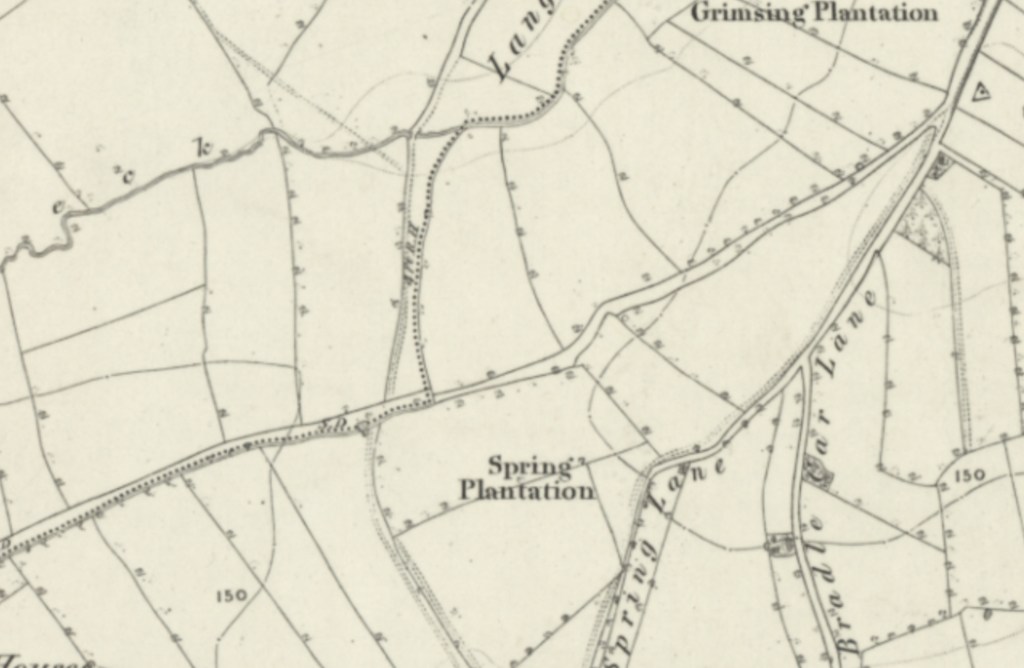
At it’s mid point were located Broad Lane Houses, today known as East Farm and West Farm, respectively. Continuing on towards South Kirkby here Broad Lane passed by a draw well and a quarry (known lovingly by many as the “bomb drop” due to a local myth that in the second world war a lost bomber dropped it’s payload in the field).
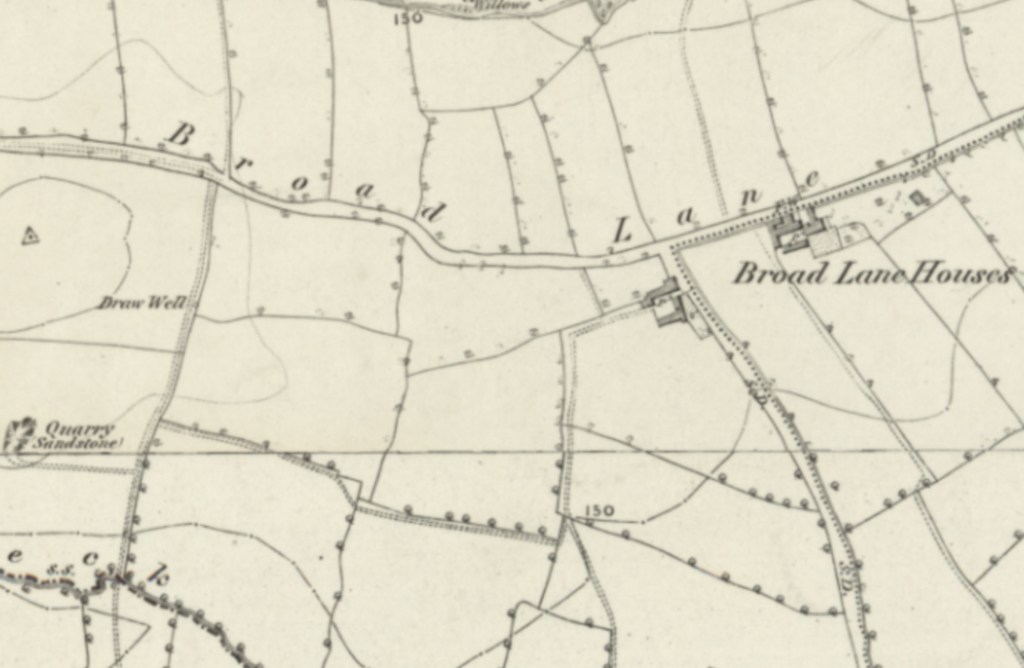
The Grade II listed East Farm farmhouse is located on the mid point of Broad Lane. This sandstone farmhouse was built some time in the 1600’s. Approximately five meters west of East Farm farmhouse is another Grade II listed sandstone building, a barn with large segmental-arched wagon doorway, that was built in the late 1600’s. In 1978 the West Farm on Broad Lane was inspected externally by archaeologists, and it was determined that the farm house was a predominantly stone laithe house, built some time in the 1700’s, and extended with brick additions in the 1800’s. A laithe house was a dwelling with other farm buildings, including a barn, as a single structural unit, with separate entrances for human and livestock areas. Unlike its neighbour at East Farm, this building was not given listed status.
In September 1867 an auction of various plots of land and buildings took place by Messrs. Waite and Crouch, at the Chequers Inn. Lot 4 was bounded on the south east by Broad Lane and was a close of grassland called Gate Saddles. Lot 5 was a parcel of arable land called Buskey Close, bounded on the north west by Broad Lane. The lots were part of a wider estate occupied by a tenant farmer known as Frederick Beaumont, who had agreed to end his tenancy and vacate the estate by the following February. The buildings said to be in “good repair” and the arable land “in a high state of cultivation.”


 The Story of South Elmsall