
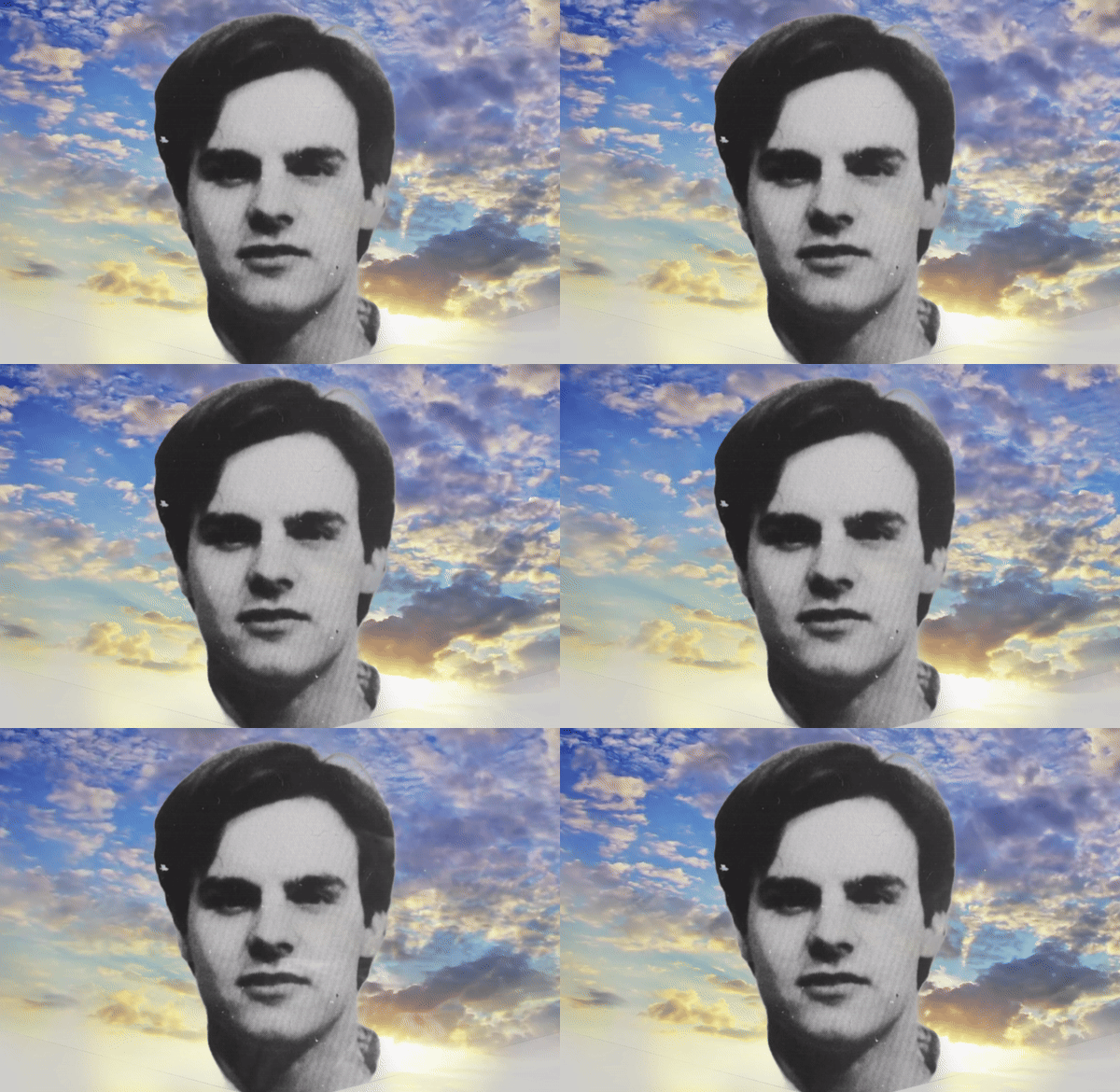
On the fourth evening of the year long 1984/85 miner’s strike, Wednesday the 14th of March 1984, David Gareth Jones of South Kirkby was critically injured whilst on the picket at Ollerton Colliery, in Nottingham. David died in hospital in the early hours of the 15th of March, he was just 24 years old.
Fate is a fickle thing, as David’s father Mark noted in his biography about David. When the strike began David was working at Ackton Hall, near Pontefract, but his car was having mechanical issues so instead of heading to meet colleagues from Ackton Hall he went with his brother, Trefor, and friends on buses from Frickley Colliery instead. The initial plan was for the Frickley Colliery buses to head to Gedling Colliery in Nottinghamshire but a police roadblock at Clumber Park stopped the buses and David and friends disembarked their bus and instead went to nearby Ollerton Colliery. His brother, Trefor, continued on the bus he was on to Gedling Colliery via a different route. As David’s father said; “If the police hadn’t stopped him he’d have gone to Gedling and would not have been killed.” Even more coincidental is that the 14th of March was the first and only time David ever went on the picket, and whilst he was born on the 12th of March, his birth was not registered until the 14th March, meaning that it was exactly 24 years from his birth being registered to the date of the events of the tragic picket.
The Sandwell Evening Mail of Thursday 15th March 1984 reported that an anonymous police source stated that David’s death “was not caused by violence” but went on to give an account of the events of the evening that contradicted that police claim. They said that David “was one of hundreds of flying pickets outside Ollerton Colliery who became involved in running street battles with local youths after taunts and claims that picket’s cars had been vandalised.” They went on to report that up to 300 miners were at the scene and that “police ranks broke after picketing miners were taunted by people coming from a public house.” The same article reported that ten people had been arrested and that Arthur Scargill had arrived that evening to disperse miners and call for people to “behave responsibly”. The Newcastle Evening Chronicle of the same evening also stated that police were adamant that David’s death was not linked to violence and noted that the flying pickets by Yorkshire miners in Nottinghamshire had gone ahead, despite the High Court issuing an injunction against miners and the National Union of Mineworkers (NUM) to stop them from picketing outside places of work that were not their own, and the Yorkshire NUM issued a statement to reaffirm their commitment to continuing “established trade union practices” and continue to picket.
The Hull Daily Mail of the 15th of March repeated the police’s stance that David’s death “was not caused by violence” but gave an account of violence and the taunting of miners similar to other publications, but the article was merely a small addition to their front page. In contrast that day’s Birmingham Evening Mail gave a different perspective, with their front page headline being “NUM defy injunction” and relegating the death of David to a sub-article under that headline. They reported that the NUM’s General Secretary, Henry Richardson, had said that “it is obvious to everyone that life and limb are in danger…” and called for members to “come out in support of the Yorkshire area” and called for unity. The same report also gave a fuller account of the attendance of Arthur Scargill at the scene of the violence at Ollerton Colliery, that night. They quoted him saying that “i want to take the heat out of the situation…” “…i want to see all my members behave.” It also gave a quote by an anonymous National Coal Board (NCB) spokesperson who said “the Board is horrified by the violence that has taken place, and if pickets had stayed at their own coalfields, in accordance with the court injunction, there would be none of this violence.” It appears then that the Birmingham Evening Mail was quite clear that the death of David was indeed linked to violence, despite police saying otherwise, and that the violence was directly attributed to the Yorkshire NUM defying the injunction to stay away from pits that were not their own, and the NCB’s anonymous spokesperson explicitly stated so.
As the news of David’s death found national attention, the details around the cause of his death continued to contradict the official inquest findings. David Nixon, who worked at Hatfield Colliery, told media including the Daily Express; “Some of those who had picketed the night shift at Ollerton heard shouting from people coming out of the pub across the road, The Plough…” “…We started running and I remember seeing this guy on the floor. My mate Errol Palmer said a brick’s hit him. I picked that brick up and put it away at the side of the road. I could see someone was injured on the floor and found David out cold, and shuddering every few seconds. There wasn’t a mark on him and no blood. The lads said he had been hit by a brick on the side of the neck. “The poor guy is gasping for breath and I heard someone say he’s got asthma, he’s having an asthma attack. They got him off the road and put him on the grass verge, they tried to calm him down but he’s really struggling to breathe. The ambulance then came and it was about an hour later he passed away, and of course then we were really upset. We were all milling about and talking to each other.” Errol Palmer, another miner who witnessed the events, told the Daily Mail that “bricks, bottles and pieces of fencing were being thrown at us. The lad went down, a brick hit him on the head.”
The Home Office opened an inquest into David’s death within hours of his passing, with David’s brother, Trefor, and his father in attendance. David’s father, Mark, provided his version of events at that inquest in the biography that he wrote about David. “A Sergeant Keith Bell met us at Mansfield and a Superintendent explained to us what had happened. He said David had run towards some people who were damaging picket’s cars. He said a stone had hit him and that he had collapsed. There were no marks, he said, only a tiny bruise.” After identifying David’s body, his father went to the preliminary hearing, that lasted just ten minutes. and the Pathologist stated that David’s heart had been damaged by injuries that occurred an hour before his death. This stuck in David’s father’s mind because David was thought to have been struck by a brick around 11:30pm, when he collapsed, and this had led police to investigate the hour directly prior to that event, where in reality David had died at 12:11am, so it was clear to David’s father that the police had been looking at the wrong window of time all along. On Friday 16th of March 1984 The Scotsman published details of the quickly carried out Home Office inquest into David’s death, and found that he suffered injuries which “could have been caused by a crushing impact on the chest such as by a wheel, a post or vehicle”. Witnesses maintained that David had collapsed after being hit in the back by a brick, but Pathologist Dr Stephen Jones (no relation) was adamant that there was no indication of assault, that David’s injuries were not caused by a blow from the truncheon of police, and that the brick did not cause the injuries that led to David’s death.
David’s father wrote in the biography he authored about his son that he had spoken at length, personally, with eyewitnesses who all clearly stated that David had been sat on a grass verge at the entrance to Ollerton Colliery, after being involved in a chase with people who had been throwing stones, at 11:15pm, and that he was physically fine. Closer to 11:30pm came the shout that picket’s cars had been vandalised and David and others ran towards the cars, away from the colliery entrance, and there David was struck by a brick thrown by someone from behind a parked car. These miners gave statements to the police but at the inquest they were never called to give testimony, so their statements were pointless. He wrote; “David’s two mates Tony Short and Andy Slain kept telling me that the police were all wrong. I used to reply that the police had said the fatal injury was an hour before he collapsed. But Tony would repeat that it wasn’t like that.” “When Superintendent Thompson and Sergeant Bell came to do the inquiry, they said they took 270 statements.” “They kept telling us that the injury occurred in the hour before David collapsed.” “When it came to the inquest i had expected to get to know everything that had happened.” “During the morning police produced twelve witnesses. Out of those, ten only gave evidence on how David arrived at Ollerton.” “He had arrived at Ollerton at 10:10pm and gone to into the pub with two other lads. That was all the evidence of ten of the twelve witnesses. Of the other two, one had seen the brick hit him.” “Tony Short and Andy Slain who were with David throughout the whole time of the incident, and there were more of them who had seen everything, but were never called.”
In the afternoon of the inquest the Pathologist gave evidence that David had suffered two injuries. One was evident in the form of a bruise at the top of his chest, where the brick had struck David, and another was a serious and fatal injury in the region of David’s heart. The Pathologist claimed that a victim of such an injury could survive at most an hour, post injury, and only if laid still. Mark Jones said; “The police evidence up to 11 o’clock was worthless, and only one of the witnesses who were with David after 11 o’clock were called. I could see the entire police inquiry was a load of rubbish and they knew it. They were in the wrong time zone altogether. Even the Pathologist had said the brick injury could have been the first, and the more serious injury had happened afterwards. That poses a lot of questions as to what had caused the second injury. Those questions were never answered.” What is also curious is the witness testimony provided by an off duty policeman who coincidentally happened to be drinking in the very same pub that evening. This police officer, corroborated by his own father who was there also, stated that at 10:35pm 10 or 12 picketing miners broke through the police line and were crushed up against a car. This was never fully investigated. Even more bizarre was the testimony of a woman visiting a fish and chip shop at 9:30pm that evening but who also stated that she saw 10 or 12 miners crushed against a car, at 10:30pm, and that she recognised David as being on of them, from a photo of him published in the paper. When asked how she had come to provide evidence after the fact, she said she happened to be in the police station to report a different incident, when she realised she had witnessed the event unfold and gave evidence. Alarmingly this evidence also included a full description of David, including his clothing, but it transpired that she had already been shown photographs of David’s clothes by police, before making her statement. Given that it was dark, and the woman and the off duty police officer still somehow managed to be on the scene and pick out David as one individual at that event, there are serious questions as to what this evidence was being used for. Were police trying to paint a picture of David as being violent in breaking through a police line? Were they trying to explain away the mysterious crush injury? The jury at the inquest arrived at an open verdict, which was inevitable due to the fact that potentially important eyewitnesses were never called by the Coroner, and the confusion around the timeline of events, and which injury occurred when.
David was known by his family and friends as a bit of a rebel, in the biography written by Mark Jones, David’s father, he called him a “loveable rogue” who lived life to the full. The Scotsman, on Saturday 17th of March 1984, along with a small number of other newspapers across Britain, published an article noting that David was due to stand trial, at the time of his killing, “on charges of football hooliganism” and that he was awaiting appearance at Crown Court to defend the charges. Three weeks prior David had been one of a number of men who had clashed during an FA Cup tie between Frickley Colliery and Whitby Town. David had appeared before magistrates court in Whitby, on charges of possessing a offensive weapon and conduct likely to cause a breach of the peace. According to the article in The Scotsman the weapon was a piece of wood, and David had denied the charges and elected to raise the case to Crown Court, to clear his name. In contrast, in the biography of David, written by his father, Mark, he reflected on the findings of the inquest into David’s death that on the evening of his death David himself had provided first aid to a colleague from Mansfield, who had been injured in the violence at Ollerton Colliery. The Mansfield miner had suffered a cut requiring stitches and David had provided some initial checks before sending him for first aid. An eyewitness told of how the miner had run into the pub as the situation outside had begun to unfold, and that David had obtained a first aid kit from a women working in the pub to clean up the cut. David was a committed member of the St. John’s Ambulance service for many years, where he had won recognition nationally for his talent as a first aider.
In the build up to David’s funeral the family were placed under further stress when the Coroner initially refused to release David’s body for up to three weeks after his death. In the biography written by Mark Jones, he maintained that the Coroner’s office only backed down when his other son, Trefor, pursued the Coroner to explain why, but no reason was ever given. “…no-one had any objections to David being buried. Trefor phoned the police, they had no objection. The Pathologist had no objection, and nor did the NUM Solicitor but the Coroner’s office would not give them a reason for holding his body. I know what i think. And i’m convinced that it was a deliberate ploy to take the heat out of the situation. To try and stop the miners coming together…” “…the refusal to let his body out was to stop them having something to fight for…” “…how can one human being deliberately do that to someone who has lost a son…” “…deliberately hold up the funeral for political reasons…” “…somebody made that decision and it must have been someone at the top.” “They can deny it was from the top until hell freezes over, but i know…” “…I know who it was.”
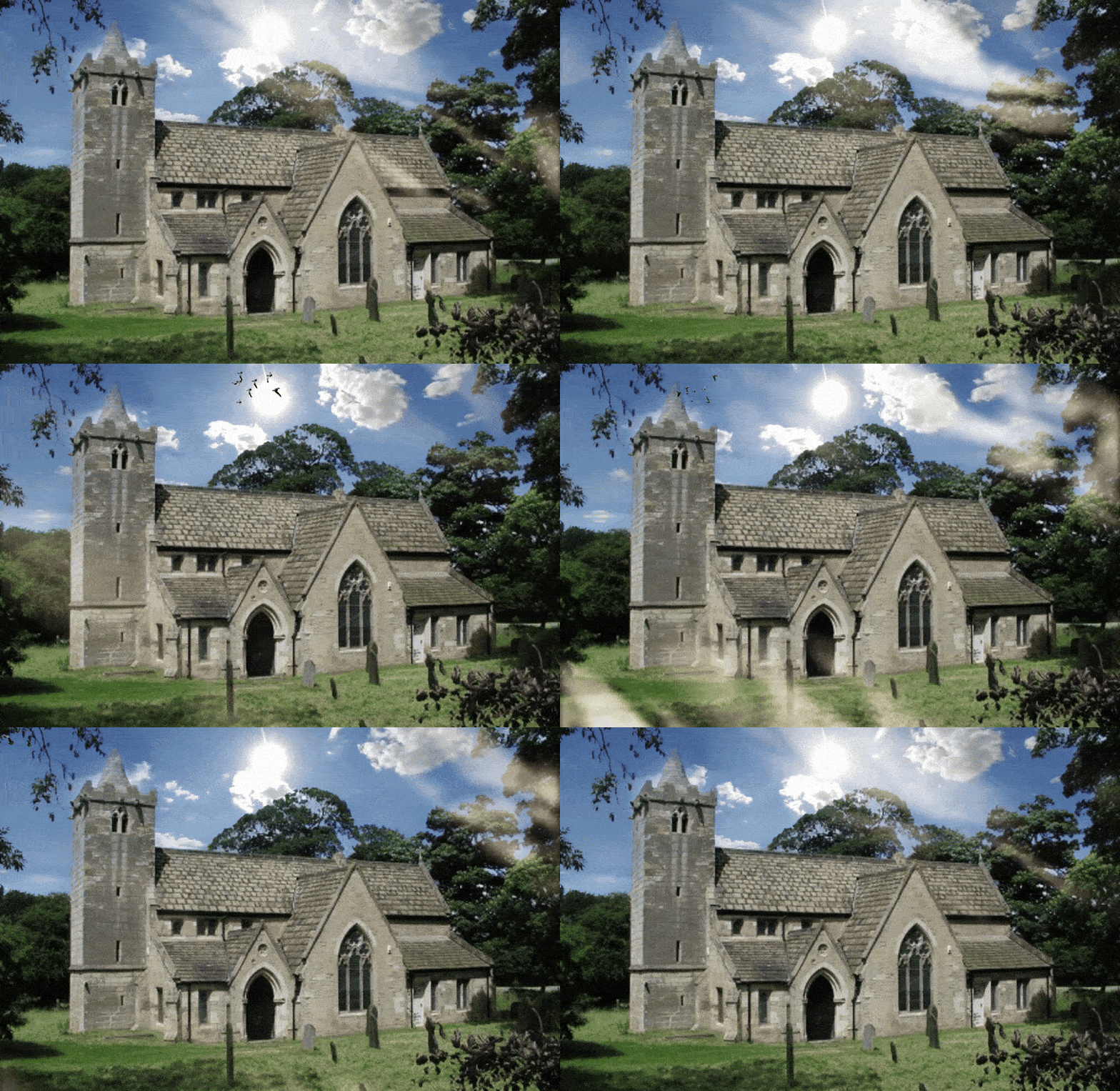
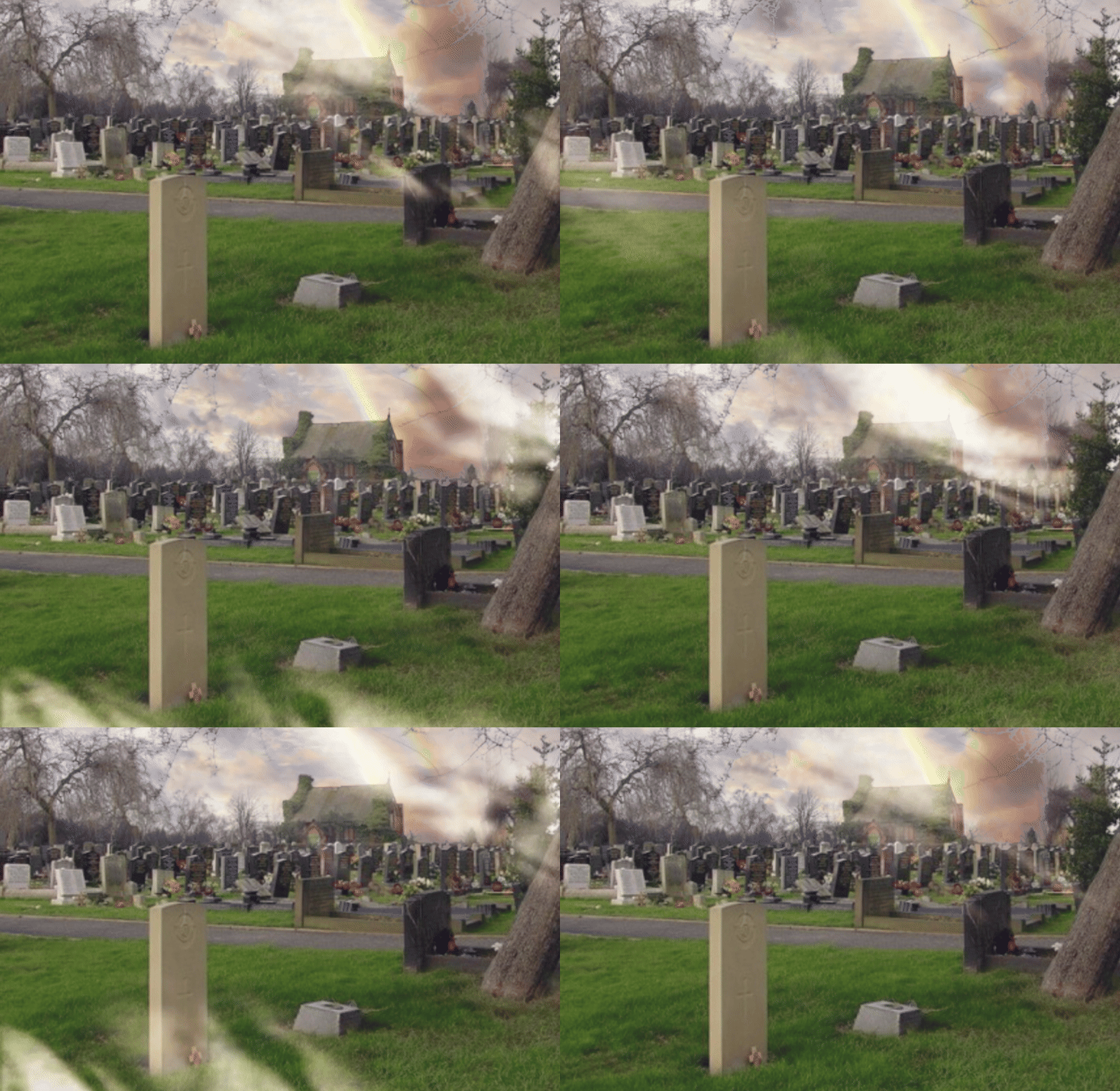
David’s funeral took place on March the 23rd, with a service at All Saint’s Church in South Kirkby, and was attended by thousands of miners from all over the country and was covered nationally by press. Leading NUM figures, including Arthur Scargill, personally visited David’s family and the procession that began at Saxon Mount, by some reports, was up to half a mile in length. David was laid to rest in Moorthorpe Cemetery. David was survived by two children.
David’s father, Mark, said it best. “David had been killed on a picket line but it didn’t bother them one little bit. They tried to stop his funeral. They covered up what really happened.” “The police have so much power in their hands. If they hadn’t used that power to stop David at Clumber Park, he wouldn’t have been at Ollerton to start with. Those things never came up at the inquest. What law gave them the right to stop David?”


 The Story of South Elmsall