
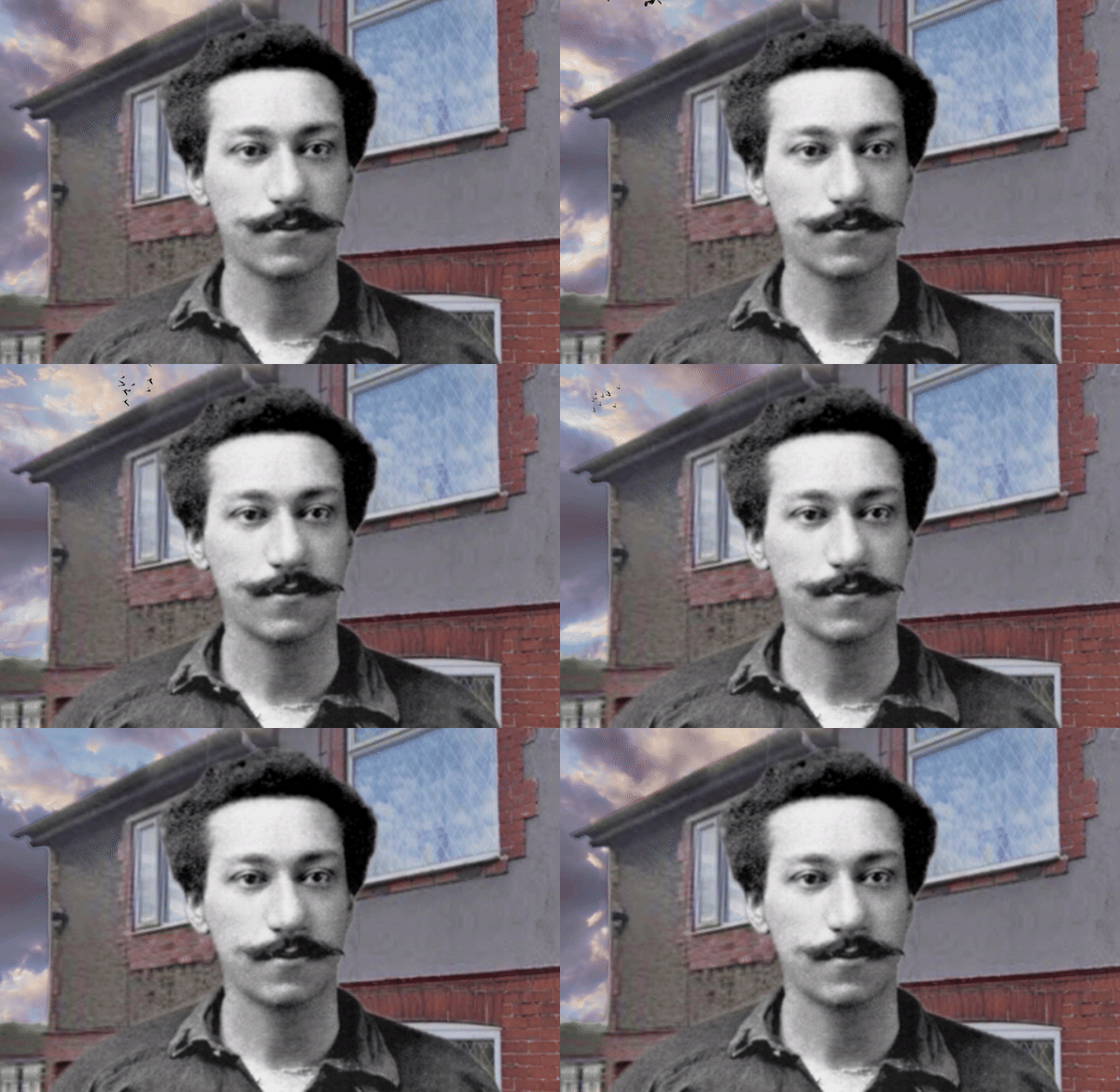
Arthur Wharton was born in Jamestown, on the Gold Coast (now Ghana), in 1865 and after coming to the United Kingdom to study as a Methodist missionary he went on to become probably the first African man to play cricket in Yorkshire and in 1886 he set the Amateur Athletics Association 100 yard sprint record of ten seconds (a world record). Arthur went on to play professional football in the Football League and also played as an amateur in the Football Association Cup, being now recognised as the world’s first black professional footballer.
Much has been written about Arthur’s early years in sport, as a record breaking sprinter, cricketer and footballer, but his later sporting years have been somewhat ignored by most. It seems widely accepted that just after the turn of the century Arthur found a struggle with alcohol and retired from football but this simply is not the case, he went on to play football at a high level well into his forties and even when he began to concentrate more on his cricket he still played football locally in Yorkshire for some time, a part of that time being in our own community.
The currently widely accepted narrative is that Arthur retired from football whilst at Stockport County, around 1902, though it is also currently quite well known that he actually went on to play for Denaby. In December 1906 it was reported that Arthur had signed for Rotherham Main, from Denaby Main, where he had been for two seasons. It was also stated that Arthur had joined Denaby from Stalybridge Rovers. As he had reportedly spent two years with Denaby this leaves a gap, roughly from 1902 to 1904, where it is not clear where he played, though, if the newspaper report announcing his signing for Rotherham Main is accurate at some point in this period he returned to Stalybridge Rovers for a third time in his career. These years still require some investigation. In March 1907 it was reported that a goalkeeper “who has seen much Rotherham football in days that are past was Wharton…” “…is now with Rotherham Main”. One particular match report from April 1907 is of specific interest, when Rotherham Main (with Wharton in goal) lost to South Kirkby in the Sheffield Association League. It is beyond doubt that Arthur was still playing football at a competitive level as late as 1907, aged 41. In August 1907 it was reported that Arthur had transferred from Rotherham Main to the Dusty Miller Inn, a pub team in the Rotherham Licensed Victualler’s League. Arthur was still revered as a football player locally in 1908, when he arranged for a select A. Wharton Team to play a select A. Mangham’s Team, in Wath, for the benefit of a Mr C. Birks. It appears that Arthur left Dusty Miller after one season, to join Rotherham Commercial (Commercial Hotel), also in the in the Rotherham Victualler’s League. In 1909 Wharton, played for Commercial Hotel versus Atlas Hotel, in the Rotherham Victualler’s League, semi-final, in front of over 2,000 spectators. It was the third attempt at the tie and Arthur’s team lost. It appears obvious though, that this step down in level of football owed as much to his preference for cricket as to his ageing body, as he was given leave to miss games for his new team to play for Rotherham Town Cricket Club.
Arthur was undoubtedly a talented cricketer. A match report of Rotherham Town Cricket Club versus Mexborough, from July 1908, stated that “the dusky Wharton still proves troublesome and his 29 was characterised by his usual healthy methods.” The 1907 annual meeting of Rotherham Town Cricket Club stated that an A. Wharton had a very respectable batting average of 30.07 runs per innings. In August 1907 Arthur clearly still was something of a celebrity, appearing in a benefit match for a seriously injured cricketer, boosting ticket sales. Another example of Arthur using his status to benefit others was reported in May 1907, when “Wharton of football fame” appeared for Rotherham Town Cricket Club as part of the Whitsun Carnival. The longevity of Arthur’s cricketing powers is evident through the fact that even as late as 1919 “the West Indian, Arthur Wharton” was still playing cricket for his employer, Yorkshire Main.

Arthur Wharton was recorded as occupying 105 Clifford Street, Moorthorpe at the time of the 1911 census, along with his wife, Emma. The 1911 census records Arthur’s life as his sporting prowess was on the wane, with his occupation listed as a collier (geographically most likely to be at Frickley or South Elmsall Collieries), following a career that saw him play professional football for Preston North End, Darlington, Sheffield United (and one notorious game for their bitter rivals Sheffield Wednesday), and Rotherham United. Census records show that prior to 1911 Arthur was the landlord of the Albert Tavern in Masborough, Rotherham, in 1891 and ran a tobacconist shop in Ashton-under-Lynne in 1901. It is worth noting that local collieries had well respected football, cricket and athletics teams, and it seems logical that Arthur would have had some connection to the sports team of his employer, as a devout sportsman who continued to play professional cricket until into his forties. It was not uncommon for sports teams to bend the rules by paying players of stature to work their host employer. It is not clear when Arthur left Clifford Street, though it is known that Arthur moved to Edlington sometime around 1915 and was employed at Yorkshire Main Colliery. It was reported at the time of his death that Arthur “took a keen interest in all kinds of sports in the village” and “he was very popular and made a host of friends.” This reinforces the belief that Arthur would not have turned a blind eye to the sporting prowess of the South Kirkby and Frickley colliery sporting teams, whilst a resident of Moorthorpe. There is a reference to an A. Wharton playing cricket for Rotherham Town Cricket Club against South Kirkby as late as 1908 and this is almost certainly Arthur. There is also evidence of a Wharton playing at South Kirkby, for Rotherham Town Cricket Club, in 1907. So, we know with some level of certainty that Arthur was probably familiar with the excellent South Kirkby Colliery sports ground, prior to him arriving to live in Moorthorpe, South Kirkby by 1911.
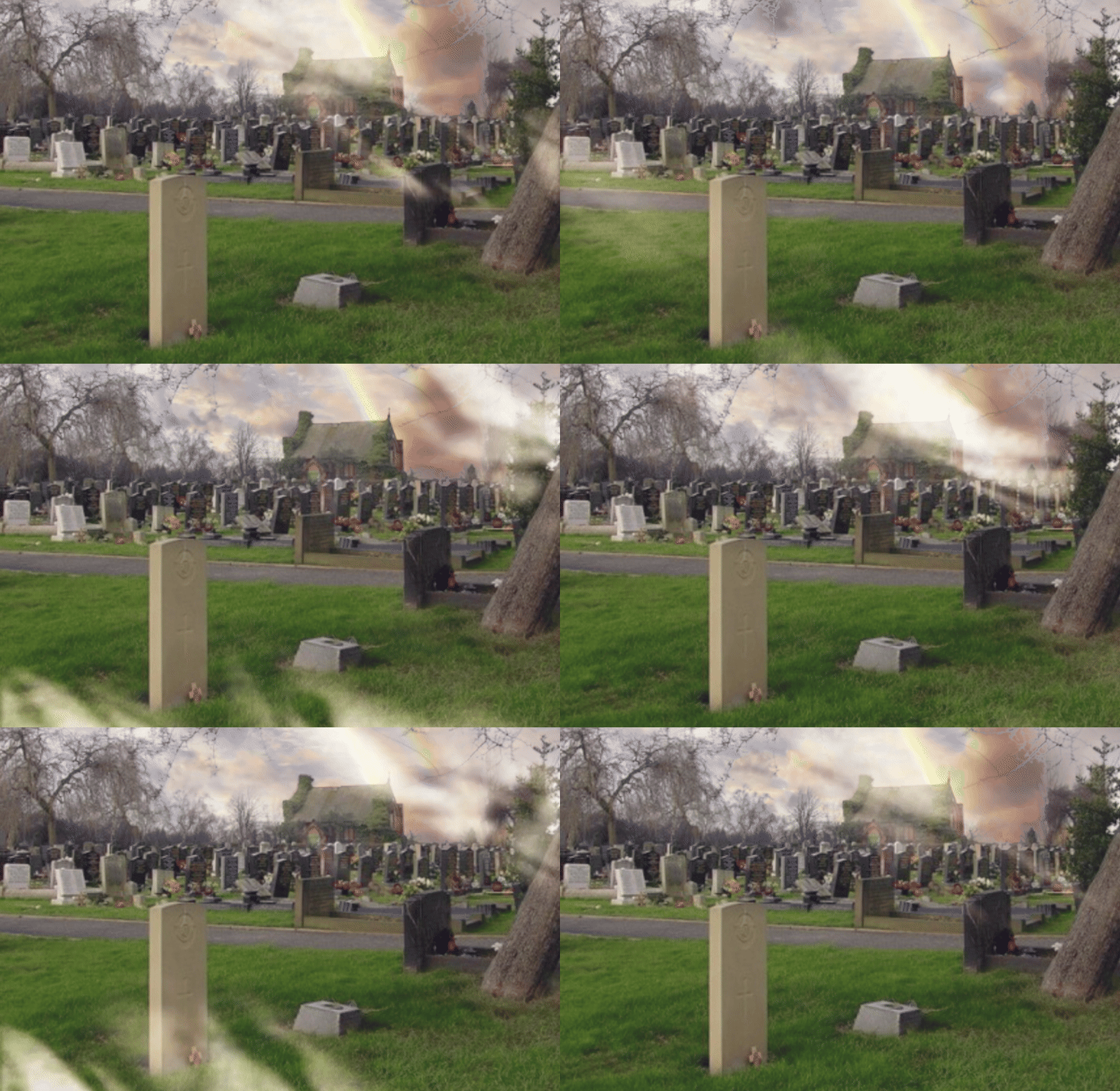
Arthur was still taking part in athletic events as late as 1915. On the 2nd of August 1915 he challenged Harry ‘Chubby’ Fellowes of Chesterfield in an 100m sprint, at Mexborough Athletic Ground. Arthur though, it appears, was past his best and “broke down in the last 50 yards”. In 1916 Arthur once again competed, this time in aid of the Edlington and District Soldiers Welcome Home Society, on the Edlington cricket field. The ravages of time had clearly caught up with Arthur and he was unplaced in his race, though clearly he still loved sport and wanted to do his bit. Arthur continued to work in collieries around South Yorkshire until his death in 1930, when he was buried at Edlington, South Yorkshire. Largely forgotten to history Arthur lay in an unmarked grave for 67 years and the legacy of Arthur has only recently begun to be fully recognised. Following the establishment of the Arthur Wharton Foundation the English Football Association, UEFA, FIFA and a number of the football clubs for which Arthur played have all recognised the cultural significance of Arthur as a black man who battled against the Late Victorian view that black men were of inferior intellect and sporting ability than white men. As a result of the increased awareness of the life and achievements of Arthur there are now moquettes recognising him at the headquarters of both FIFA and UEFA and statues at the ground of Rotherham United and at St. George’s Park (the National Football Centre in Staffordshire).



 The Story of South Elmsall