
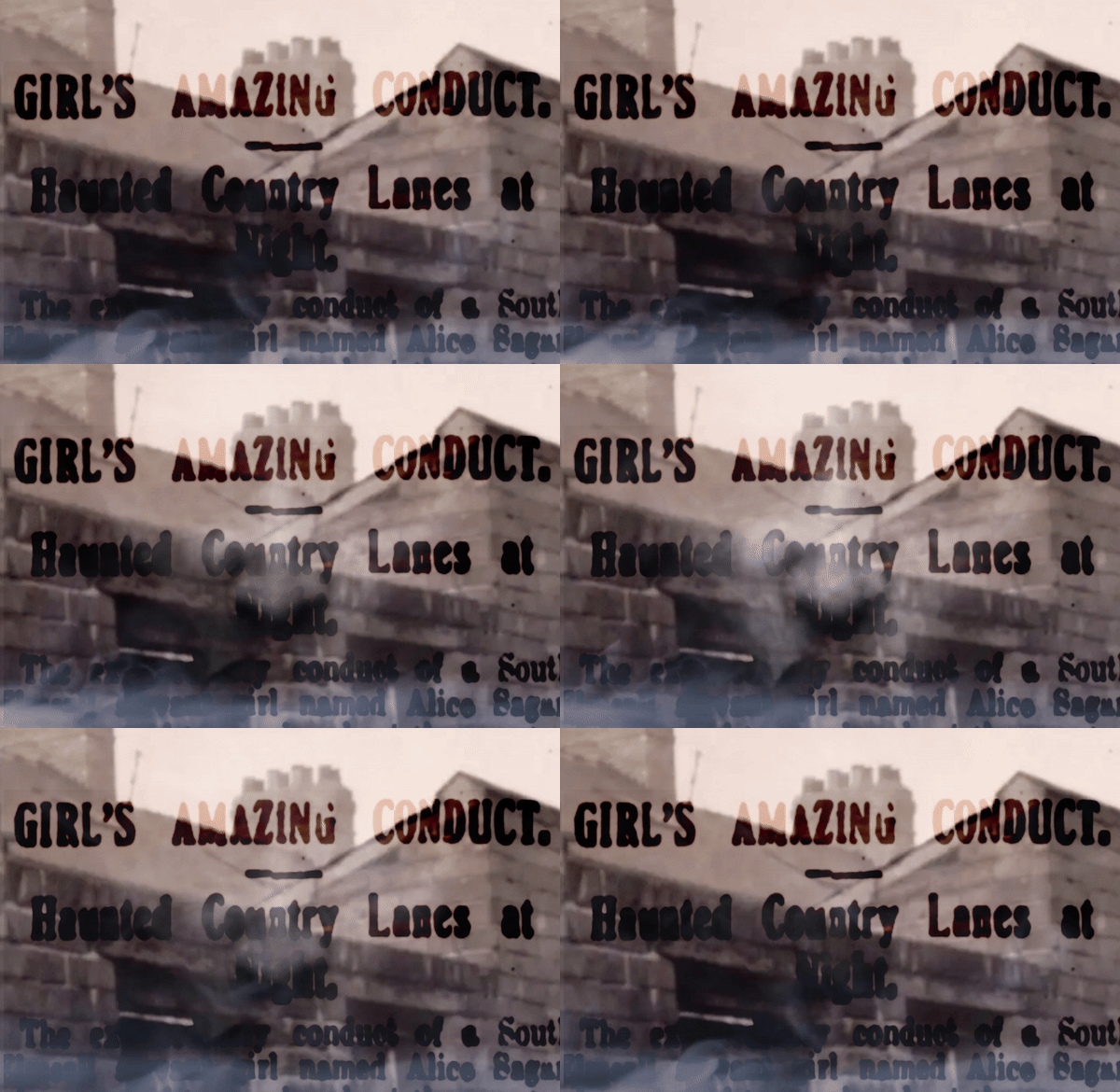
On the 21st of May 1911 the Empire News published an article with the headline “Girl’s Amazing Conduct – Haunted Country Lanes at Night”. The article went on to describe a bizarre incident that had occurred close to nearby Barnburgh, when a young girl was found once again wandering the secluded lanes, at first glance something of a horror story. The article noted that Alice Sagar, a servant girl from South Elmsall, “was said to wander about the countryside at all hours of the night” and was reported to be known to act in “extraordinary conduct” when doing so.
Alice appears multiple times in prison records and rather than being a ghostly apparition, she appears to have been a rather unwell young woman. The records show that Alice was noted as being born around 1894 and a domestic servant and a char lady. In January 1910, when Alice would have been 16 years of age, she was charged with four counts of larceny (stealing clothing), and bound over, at Pontefract Police Court. A Wakefield Express article from the 29th of January noted that the bench were not asked to hand over custody of Alice to her father because her father had refused to have her back at home “on account of her general conduct”. This article also added some extra context on Alice’s crimes, she had stolen a pinafore belonging to Lydia Longden of 191 Grimethorpe Street, South Elmsall. The pinafore had been on a clothes line and was found in the possession of Alice, and she said “i took it”. The next charge was of taking a rug from 192 Grimethorpe Street, the property of Thomas and Margaret Cairns. Again this was taken from their yard and Alice admitted to local Police Constable Kaye that she had taken it and placed it near the beck, on Kenyon Street. The third charge was, frankly, baffling. Alice was accused of taking a further rug, from the yard of sixteen year old miner Walter Price of Kenyon Street. Alice had knocked on the door of Walter Price and asked him if he had a rug (his had been stolen from his yard), and when he went to fetch the police he found a rug against his door. The final charge was of taking various clothing from the yard of Ella Hutchinson, daughter of a Moorthorpe draper. Again these were found in the possession of Alice and she admitted guilt. In March 1910 Alice was brought back before Pontefract Police Court for breach of recognizance (not sticking to the terms of her bond) and sentenced to serve the four consecutive monthly sentences for the acts of theft.
The 23rd of March Sheffield Independent was one of a number of publications that provided details of the trial of Arthur Carrington, a labourer from Mexborough, who was charged with committing arson at The Crown Inn, Barnburgh. The article noted that Alice, who was in domestic servitude at The Crown Inn, had refused to sell further drinks to the intoxicated Carrington, who had been asked to leave the premises by the landlord Albert Hardy and again later by Albert Hardy’s wife, and that Carrington had asked Alice for a box of matches, which she gave to him. The case took a curious turn, as reported by the Sheffield Independent on the 24th of March, when Alice, the key witness, was found in a dazed state. The article explained that Albert Hardy had sent Alice out to the shops and when she did not return as expected he did not send out a search party. Some hours later Alice was discovered tied to a gate in a lane near Hickleton, and was taken back to the Crown Inn and the local doctor was called to treat her for shock. She was reported to have no physical injuries.
In another twist, on the 28th of March 1911 the Leicester Evening Mail reported that Alice had been brought before magistrates at Doncaster for theft of money belonging to Albert Hardy, her employer at The Crown Inn. The article noted that Alice alleged that she had been assaulted by two men on the night that she was found tied to a gate, but this story was “discredited”. Alice allegedly confided in Albert Hardy that she had taken the money and put it elsewhere in the pub, as he was taking her to her parent’s home in South Elmsall. On returning to The Crown Inn he had found the coins exactly where Alice said he would. The Yorkshire Evening Press of the same date added that later on the evening in question Alice was found in nearby Goldthorpe “behaving in an extraordinary manner” and taken into custody by police. Records show that in March 1911 Alice was found guilty of theft, at Doncaster Police Court, and again bound over. Newspaper articles note that Alice promised to “do better” and her father said that he would care for her and the court was lenient due to the fact that she was suffering upset from the fire that she had been a witness to.
The 1911 census shows us that at this point Alice lived at 166 Queen’s Street in South Elmsall, and was the daughter of Joseph and Alice Ann Sagar. Her father was at that time employed underground at a colliery (likely to be Frickley), along with a number of her brothers, and Alice’s mother was a shop keeper. Tax records from 1910 show that Joseph Sagar was renting a shop on Doncaster Road in South Elmsall, presumably the shop run by his wife, Alice Ann. Alice was at that time one of ten children, only eight of them still living, and the family appears to have originally been from Worsbrough, and had arrived in South Elmsall via Denaby, where her then youngest sibling John had been born. The 17 year old Alice was noted simply as “doing the house work” under occupation. Working backwards from this document proves a little tricky in that the family seem to be found in the 1901 census, living at 18 Edlington Street in Conisborugh, and this document states that they were born there, not in Worsbrough. Prison records show that a Joseph Sagar, a 28 year old brown haired colliery worker, was sentenced to two months in prison, in Barnsley, for the assault of Thomas Phillips, in February 1886. It seems likely this is Alice’s father.
On the 4th of May 1911 the Sheffield Independent reported that Alice had been arrested linked to arson, when a barn in the possession of Mr J. W. Milner of Manor Farm in Barnburgh was found on fire, at 4am. The article provides important context in that it was close to Mr Milner’s farm where Alice had been found tied to a gate, and claimed to have been assaulted by two men. Police investigating the fire were told by an anonymous local source that the fire must be connected to Alice and police claimed that Alice admitted that she had left her home in South Elmsall at around 2am, that night, and that when they arrived at Alice’s home in South Elmsall after 5am she was in bed fully clothed and her boots were wet. A Leeds Mercury publication from the same date noted that Arthur Carrington, the man accused of arson in the earlier case where Alice had been called to give evidence, had been acquitted due to Alice’s strange behaviour. On the 12th of May the Pontefract and Castleford Express reported that the police in the case against Alice had failed to produce any evidence against her and she was discharged. On the 22nd of May the Sheffield Independent reported that Alice had again been arrested, this time for loitering with intent to commit arson. The article provided information that the key witness against her was Walter Kent, licensee of the Plumber’s Arms in Barnburgh. It said that Mr Kent had seen Alice at just after 10pm “loitering in the street” and that as “he knew her character” he decided to watch her and he informed police. When police arrived they found matches and paper in Alice’s possession. On the same date the Shields Daily Gazette, on reporting on the loitering charges, claimed that Alice had been found on another night claiming to have been poisoned. Crime records show that in May 1911 Alice was found guilty of loitering with intent and sentenced to six weeks.
On the 3rd of July 1911 Alice was suspected of breaking and entering into the home of a Mr Jesse Ross, where she stole a silver watch, some money and other belongings. The Yorkshire Evening Post of the 4th of July provided information that the home of Jesse Ross was at 2 St. Catherine’s Avenue in Balby and that a woman committing the burglary had left behind a scarf. Alice was reported to have claimed another woman had been responsible but that she had helped her carry away items to her sister’s home. Alice was arrested quickly but before she could stand trial, on the 4th of July, she attempted suicide by hanging in her cell, at West Riding Court House, Doncaster. The 6th of July Sheffield Daily Telegraph provided information that upon being found hanged from the bars of the window in her cell Alice required artificial respiration to resuscitate her. The same article added that when Alice finally admitted guilt of the burglary she guided police to a house on Little Lane in South Elmsall, where the stolen belongings would be found. It was also reported that Alice had also tried to drown herself in the lavatory in her cell. Ernest Pettinger, former Clerk to the West Riding Justices, noted in his ‘The Court is Sitting’ book that Alice had actually tried to hang herself twice, whilst in the cell, using rags torn from her clothing. He also confirmed that she did try to drown herself in the toilet. Even more remarkably the Daily Mercury reported on the 7th of July that Alice had tried to escape whilst being transported from Doncaster to Wakefield prison, attempting to leap from through the window of a moving train, close to South Elmsall. On the 18th of July Alice was brought before Mr Justice Scrutton at Leeds Assizes, and pled guilty to the charges, and was sentenced to three years in borstal for the theft, and attempting suicide.
On 7th of October 1913 the Sheffield Evening Telegraph reported that Alice had been arrested in South Elmsall, with possessions belonging to Hilda Owen of Balby, and was also accused of attempting to burn down the home from where they were stolen. Alice admitted theft but denied the arson accusation. The 14th of October edition of the paper noted that Alice was out on licence from her earlier conviction. The 22nd of October Leeds Mercury added context in that Alice had been staying with her married sister Annie and the rest of the Bayes family at St. Catherine’s Avenue in Balby, the very same street where she had been found guilty of committing larceny previously. This article also gave an outline of the allegation, in that Alice had called at the Owen home and briefly sat with Hilda Owen, having a chat. Hilda Owen nipped to the shops, leaving Alice in the property, at which stage it was alleged that Alice hid. The article alleged that later at night Alice came out of hiding and stole various items before setting fire to the property, whilst the residents slept. When brought to faces charges in Doncaster Alice reportedly called Hilda Owen a lair and then proceeded to sit on the dock floor, refusing to engage in the proceedings. In December 1913 Alice was finally brought before Leeds Assizes for the theft from the home of Theodore and Hilda Owen of Balby and to this charge Alice pled guilty and was dutifully found guilty by Mr Justice Darling and the jury. Interestingly Alice was found not guilty of charges of arson of the home of the Owens, the jury believed that had been accidental. Alice was sentenced to five years. The 3rd of December Sheffield Independent noted that Mr Justice Darling had remarked that Alice was “feeble minded” and that at least a prison could “look after her”.
On the 1st of May 1919 the Sheffield Evening Telegraph reported that Alice had been arrested for the attempted murder of her seven year old niece, Alice Bayes, of 4 St. Catherine’s Avenue in Balby. The report details that Alice had once again been taken in by her sister and her behaviour had become strange. Alice was alleged to have gone to her nieces school and taken her out of class, before attempting to drown her and herself, in the River Dearne. Lucikly the child survived. Leeds Mercury on the 16th of May gave further details, in that the child had heard Alice tell her to “look at the water bubbling” before pushing her in to the river, and that a witness, Eldred Hubbard, saw Alice dancing by the river and the child in the water, at which point he jumped in to save the child. It transpired that Annie Bayes had picked Alice up from Wakefield asylum and Alice had apparently gotten into an argument with her about Alice appearing later with what Annie suspected was a stolen bag. So, Alice appears in criminal records in Doncaster in the May of 1919. The notes show that Alice was accused of “attempting to drown Alice Bayes, with intent to murder her, at Mexborough, on the 30th April 1919, and aggravated assault, same date.” Mr Justice McCardie declared that Alice was “insane and unfit to plead” and she was “to be kept in strict custody until His Majesty’s pleasure shall be known concerning her.” Ernest Pettinger, former Clerk to the West Riding Justices, added to this in ‘The Court is Sitting’ when he noted that in the build up to the incident Alice had been “haunting” the local police station and superintendent’s home to the point that the police were forced to put a special officer on guard at night, fearing Alice would set fire to the premises. Pettinger also stated that every time Alice had appeared before Justices she had been referred to the Prison Medical Officer for an evaluation of her mental state but each time the report came back negative, Alice was not mentally unwell. The same publication concluded that Alice was finally committed to Broadmoor, on this final court appearance, after a prolonged medical evaluation found she had a “definite mental disturbance”.
Alice appeared again in criminal records, whilst being held at Broadmoor, on the Habitual Criminals Register. This record gives more details of Alice, including her year of birth as 1894 and location of birth as Barnsley. It also describes her as being 5ft 4in, fair skinned and dark haired, with green eyes. This record confirms that in 1913 Alice had been sentenced to five years for larceny (theft) and had been sent to Wakefield Asylum and had been sent to Broadmoor and declared “insane”. The former clerk to the courts in Doncaster, Ernest Pettifer, on reflecting on her case in ‘The Court is Sitting’ came to the conclusion that the “stupid” first sentence passed on Alice and her subsequent incarceration at just 16 years old “may have laid the foundation” for her mental decline. He opined that “the Justices who monopolised those benches in former days were gentlemen of means and position, many of them of ability, but as a body they were utterly ignorant of the conditions of the lives of the poor, their poverty and temptations, and many of their sentences proved this”. Pettinger also confirmed that Alice died in Broadmoor before she was 30 years old.
What can be certain is that what started out as a bit of a ghost story with an air of mystery in the press was actually a very sad story of a young woman who was herself haunted by mental illness which manifested itself in crime.






 The Story of South Elmsall