
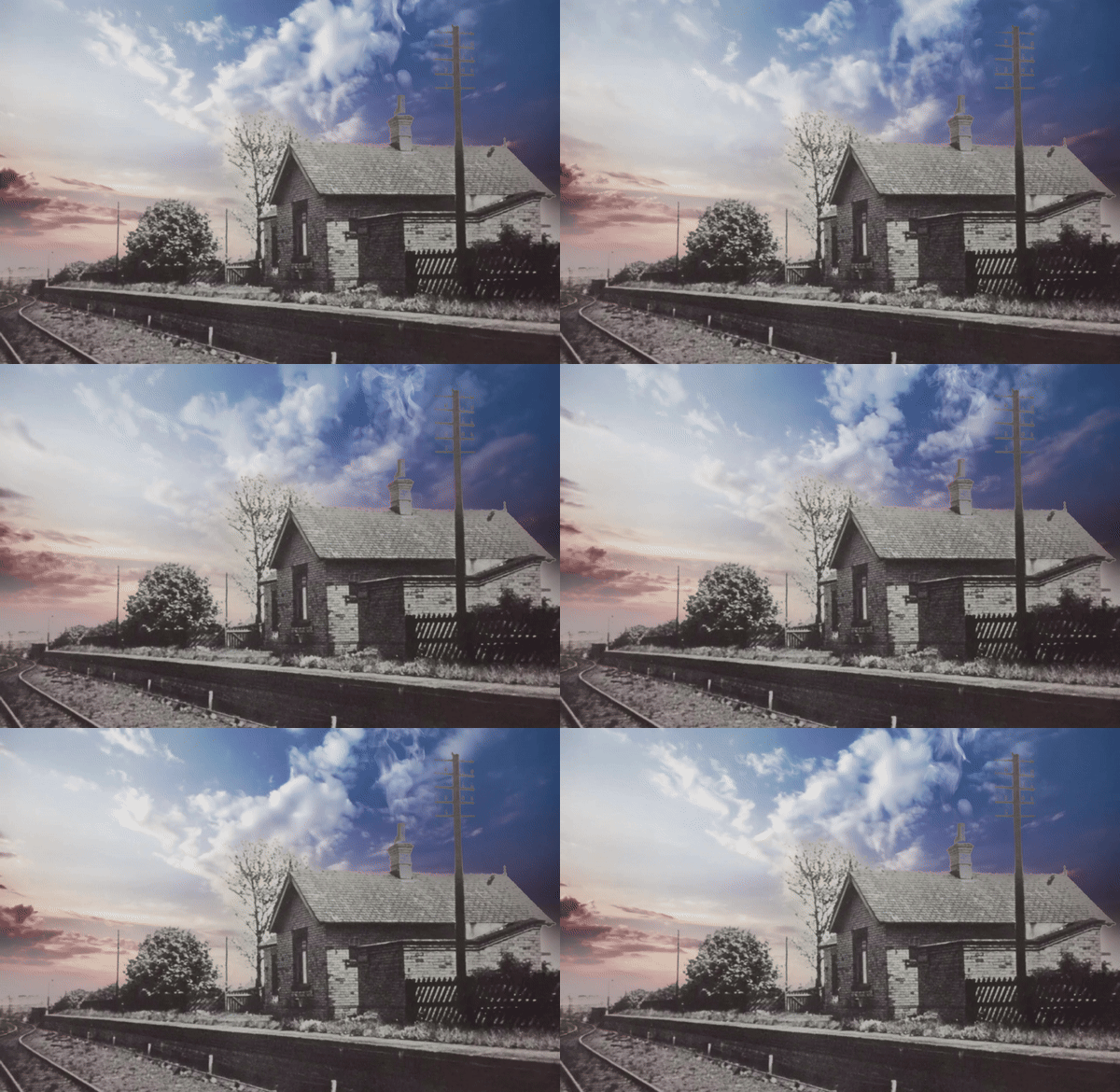
A public notice was placed in the Sheffield Daily Telegraph (and all other regional newspapers), by the Hull and Barnsley Railway Company, on 19th August 1902, to mark the opening of new railway stations on the line, including Moorhouse and South Elmsall Halt, for passenger traffic. In July of 1906 it was reported, in the Hull Daily Mail, that the Hull and Barnsley Railway Company had begun work on building a branch line from Moorhouse and South Elmsall Halt to the Carlton Main owned, Frickley Colliery.
On Saturday 22nd of February 1913 the Sheffield Independent published an “amazing story” of the plot by the Moorhouse and South Elmsall Halt Station Master, Robert Arthur Sayers, to rob a train at the station, working with the young Porter, Herbert Kean, aged 21, as his accomplice. On Wednesday 5th of February a train from Wath was due to arrive at Moorhouse and South Elmsall Halt, in the charge of a Guard called George Wrigley, who had the responsibility to receive the day’s takings in a secure leather bag from each Station Master along the route. On the day in question two station’s bags containing £2 and 5s and £7 and 14s, respectively were taken.
At the station Sayers handed the Guard, Wrigley, the bag for Moorhouse and South Elmsall, which he signed for, and the train was signalled to leave onwards towards Kirk Smeaton. Seconds after setting off the Guard, Wrigley, realised two bags were missing so brought the train to a halt, and returned to Moorhouse and South Elmsall Halt’s Station Master, Sayers, to report the theft. On arrival at the scene local police could only place the two men in the vicinity of the Guard’s van, with another Guard, Kean, having been off duty and in an unknown location. All three men were arrested, upon which time Sayers gave a voluntary confession, in the process incriminating Kean.
Wrigley and Kean had met on 4th of February at the Empire in Moorthorpe, where as the film played the pair plotted their crime, at the suggestion of Kean. It was decided that when Sayers pulled the train to a stop and placed his station’s bag into the Guard’s van, Kean would then hop down from the opposite platform and steal the other bags, unnoticed, and escape the scene. After Wrigley reported the crime to Sayers, he and another Porter left for South Elmsall and met with Kean, and reported the crime to the police, before returning back to the station. On the way back, according to the confession, Kean informed Sayers that he had the bags, whereby the pair cut them open and removed the cash, throwing the bags into a field nearby the station.
The next day the pair caught the train to Leeds, and on the journey they shared the spoils of their robbery. Kean initially denied any involvement in the crime, before later himself saying that Sayers had suggested that the pair next went to Howden to carry out another robbery, using the safe key from Moorhouse and South Elmsall Halt to access the Howden station’s cash. Both men were found guilty and sentenced to prison, and no doubt sacked by the Great Northern Railway company.
Later that same year, as reported in the Bradford Daily Telegraph on Monday 1st of September 1913, Thomas Hall, a Foreman Painter with the Great Northern Railway stopped the trains at Moorhouse and South Elmsall Halt, in a bizarre incident. The drunken Hall was seen by the Signal Man, Field, from the Moorhouse signal box, as he walked along the rails. When challenged to leave Hall attacked the signal box, smashing windows, and obstructed Field from using the telephone or signal controls, stopping trains on the line. Field eventually overpowered Hall, and locked him in a room until police came.
Passenger services at Moorhouse and South Elmsall Halt ceased on 6th of April 1929. The Sheffield Daily Telegraph reported, on 8th April, that as of the previous Saturday L. N. E. R.’s cessation of passenger services had come into effect. Despite being a busy station, from it’s opening in 1902, a reduction in services post war and the rise in bus services locally had led to a sharp decline in passenger use. L. N. E. R. confirmed that station staff would be retained, due to commercial use from Frickley Colliery. In October 1929 L. N. E. R. appointed Mr W. Jackson, a traffic apprentice, as Station Master and Assistant Yard Master at Moorhouse and South Elmsall Halt, along with the same responsibilities at Upton and North Elmsall station and Hemsworth and South Kirkby Station, as reported by the 29th of October Leeds Mercury.
A group of “mischievous” boys from South Elmsall, one aged 10 and two aged 13 years of age, were charged at Doncaster, on the 27th of May 1931, with a number of crimes on the railway. As reported in the South Yorkshire times, the following Friday, Arthur Barker came on duty at the Moorhouse signal box and on arrival found the window broken. On entering the signal box he found that a locker had been broken into, papers were scattered on the floor, disinfectant had been emptied into the fire bucket and ink was poured into the drinking water. More seriously, in terms of potential railway incidents, the clock had been stopped and the telephone, which was used for regulating trains, had been interfered with. The boys were ordered to pay 30 shillings each costs. The 28th of May Sheffield Independent reported that the three boys also stole a railway signalling lamp. On Friday 21st of October 1932 a new Station Master was reported to have been appointed at Moorhouse and South Elmsall Halt, in the South Yorkshire Times. Mr J. B. Battrick, who had been Station Master at Sykehouse for 12 years, was appointed to replace the outgoing Station Master, who had moved to York.
On Sunday 4th of April 1937 the village of Hooton Pagnell was cut off from the outside world when a lorry smashed into the pole carrying the villages telephone lines, outside Moorhouse and South Elmsall Halt, as reported in the Hull Daily Mail. The driver had a miraculous escape, without injury. It was reported in the South Yorkshire and Mexborough Times, on Friday 8th of April 1938, that on the previous Sunday 17 year old George Arthur Maxfield, of Doncaster Road, South Elmsall, had been knocked down by a lorry by the railway bridge at Moorhouse and South Elmsall Halt. George was taken to Warde-Adlham, and had a fractured skull and was still unconscious on Thursday 7th of April. Another road incident took place at the station in October of 1939, when a motorbike carrying two men crashed into a ditch outside the station. The 21st October Penistone, Stocksbridge and Hoyland Express reported that driver Frederick Holgate of Arundell, aged 41, was taken to Warde-Aldham with a spinal injury and his passenger, George Parkin, of Barnburgh, aged 57, with a cut to his face and head.
The Hull Daily Mail announced on the 2nd January 1941, that L. N. E. R. had appointed Mr T. W. Shaw as acting Station Master at Moorhouse and South Elmsall, moving from Carnaby, where he was Station Master. On the 4th of September 1943 the Staffordshire Advertiser reported that L. N. E. R. had appointed Mr R. Reeves, a Signal Man at Grindley, as new Moorhouse and South Elmsall Station Master.
On Monday 13th of August 1956 railway workers in the area around Moorhouse and South Elmsall Halt discovered a scene of chaos, when arriving at work, as reported by the Bradford Observer. The Observer reported that approximately 52 coal wagons, stored on a disused section of line near Thurnscoe, had been uncoupled one by one, and their brakes released, sending them careering down the incline into South Elmsall, where the rise in gradient at the halt brought them to a stop. A dozen wagons had derailed, and 40 were badly damaged, with an estimated cost of £1,000 damage done. Youths were initially blamed for the act. By the 27th of August the Observer was able to report more accurately what had happened, when six Thurnscoe schoolboys, aged 14 and 15, were found guilty of the crime. The group of boys, it transpired, had uncoupled 88 wagons and sent them as runaways down the line, causing £957 and 18s of damage.
Doncaster Juvenile Court heard testimony from Frederick Barrett, a Signal Man, who noticed a stream of wagons running through Moorhouse and South Elmsall Halt, from Thurnscoe. Acting fast, Barrett and Frank Fish, a Frickley Colliery Watchman, managed to incredibly stop 47 wagons but many were travelling too fast to stop. One of the boys confessed, saying “we got them moving to ride them” and one of the boy’s fathers bemoaned the lack of opportunity to play in Thurscoe, saying “the area is overcrowded and they have nowhere to play. It is a well known fact that men and youths play on these wagons.” The excuse didn’t work, one of the boys was sentenced to remand home, the others placed on probation and ordered to pay costs.
Around 1979 the rails through Moorhouse and South Elmsall Halt were finally lifted and salvaged for scrap, today the Station Master’s house and platforms can still be seen, but most of the rest of the station’s buildings and fittings have been demolished.


 The Story of South Elmsall