
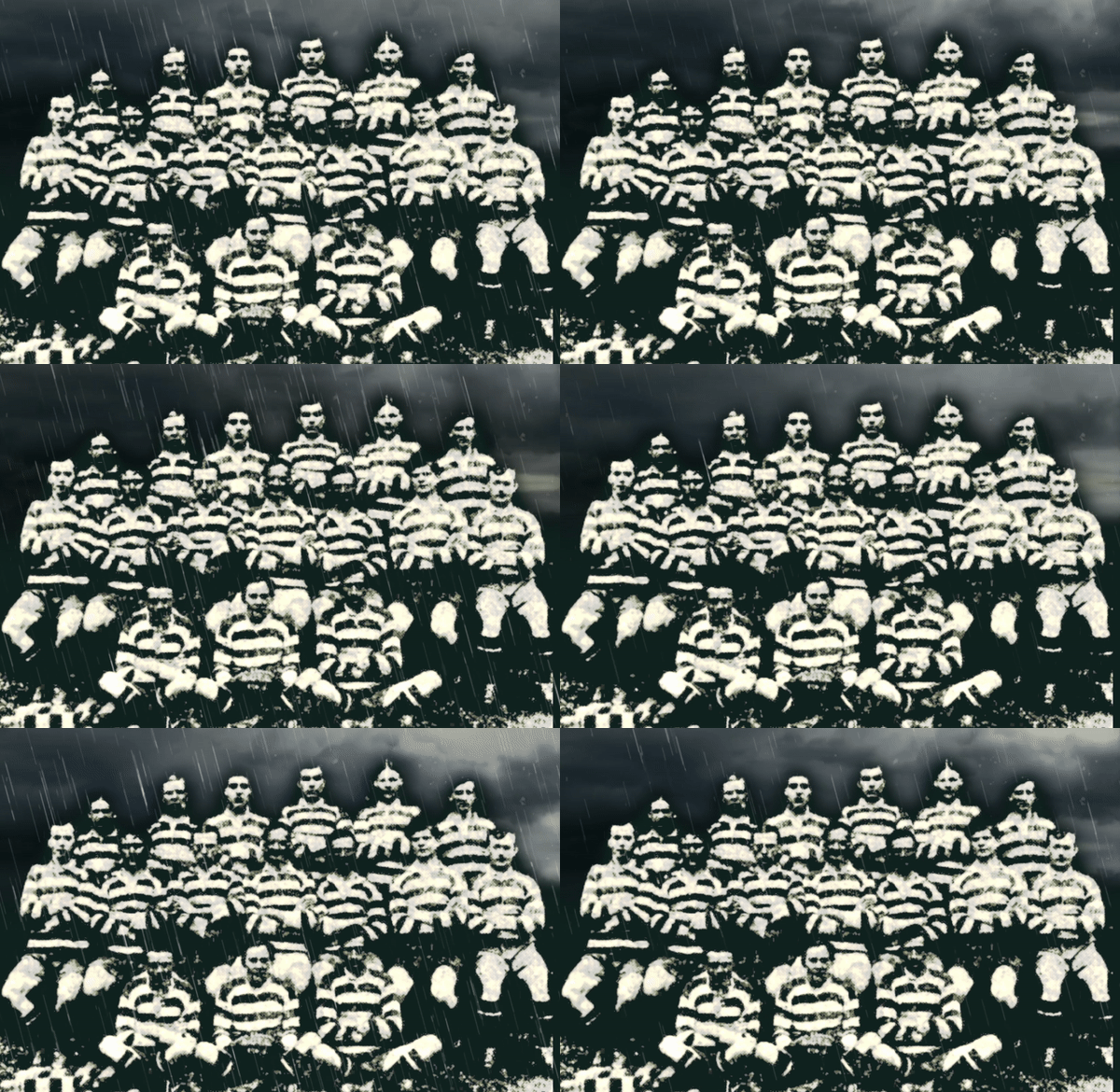
Above: South Elmsall Rugby Football Club’s 1920/21 squad. Back row, left to right; W. Clayton, E. Gibson, H. Newsome, A. Thomas, G. Grey and C. Carter. Middle row, left to right; H. Nicholson, E. Chapman, D. Cartwright, Rev. Greenstreet, L. Gibson, C. Clayton and G. Hewitt. Front row, left to right; S. Price, R. Milner and R. Carr.
During a miner’s strike, in the autumn of 1920, a group of players organised a one off game at Frickley Colliery’s (now Frickley Athletic) Westfield Lane stadium, and from this game the South Elmsall Rugby Football Club was born, under the leadership of Dr Pyecroft. To secure funding and a ground on which to play Dr Pyecroft secured support from Mr E. Preston, Mr Tyas, Mr Pullein, Mr Richardson and other notable locals. This inception story was covered by the South Yorkshire Times, on 7th May 1921, after the club’s successful first season in Yorkshire Rugby Union. Mr Tyas was likely to be J. W. Tyas, who was reported in the South Yorkshire Times on 29th November 1929 as having been a Dewsbury player in his youth, and was part of their 1881 Yorkshire Challenge Cup winning team. This small group of locals decided that “the time was opportune to give the rugby game a start in the village”. It was also agreed upon that the club should be amateur. Mr F. Cookson was appointed as Secretary and the initial Committee was made up of the above named men, and others, including Mr E. Smith, Mr J. C. Smith, Mr J. Hulme and Mr Bedson. The Yorkshire Rugby Union’s competitions had been halted between 1915 and 1920, due to the First World War, so the new team were joining at an opportune time.
The first season saw a team of enthusiastic but totally inexperienced players assembled who, with the exception of Reverand J. W. Greenstreet, Vicar of South Kirkby, had never played rugby union before! The South Yorkshire Times 7th May 1921 article noted that at the end of the season dinner event, Mr Jefferson of the Hull and East Riding Club, stated that “the forwards of the local team were the equals of any pack in Yorkshire”. By the close of the 1920/21 season South Elmsall has played 18 games and won 14 of them, scoring 266 points and only conceding 41 and they were unbeaten at home, with the same 7th May 1921 South Yorkshire Times report noting the ground was known as the ‘Common End’ ground. There is no direct evidence of the whereabouts of this ground, but the name suggests that it could well have been off Doncaster Road.
In that first season, in 1920/21, the following men were try scorers; Hewitt (10 tries), Carter (10 tries), Milner (7 tries), L. Gibson (7 tries), Price (5 tries), Thomas (5 tries), Carr (5 tries), Cartwright (3 tries), Nicholson (3 tries), C. Clayton (3 tries), W. Clayton (2 tries), Greenstreet (2 tries), E. Gibson (2 tries), Bostock (2 tries), Chapman (1 try), Sutton (1 try), Cooper (1 try) and Richards (1 try). Thomas particularly stood out, and he went on to play that season in exhibition games for leading club, Liverpool, with the blessing of South Elmsall.
However, it was also noted in the South Yorkshire Times end of season report of 7th May 1921 that the attendances had been poor, partly due to industrial disputes and partly due to clashes with other sporting events and there were concerns that the club couldn’t run without improves attendances and finances. It was also announced that in the 1921/22 season there would be a second XV team, for less experienced players to develop and the club were confident of another successful season in the Yorkshire Cup.
On 24th February 1923 the Penistone, Stocksbridge and Hoyland Express reported that S. Hyde, a forward with Featherstone Rovers (who had recently become a professional club in the Northern Rugby Football Union/rugby league code) had been transfer listed. Hyde was a product of the South Elmsall club.
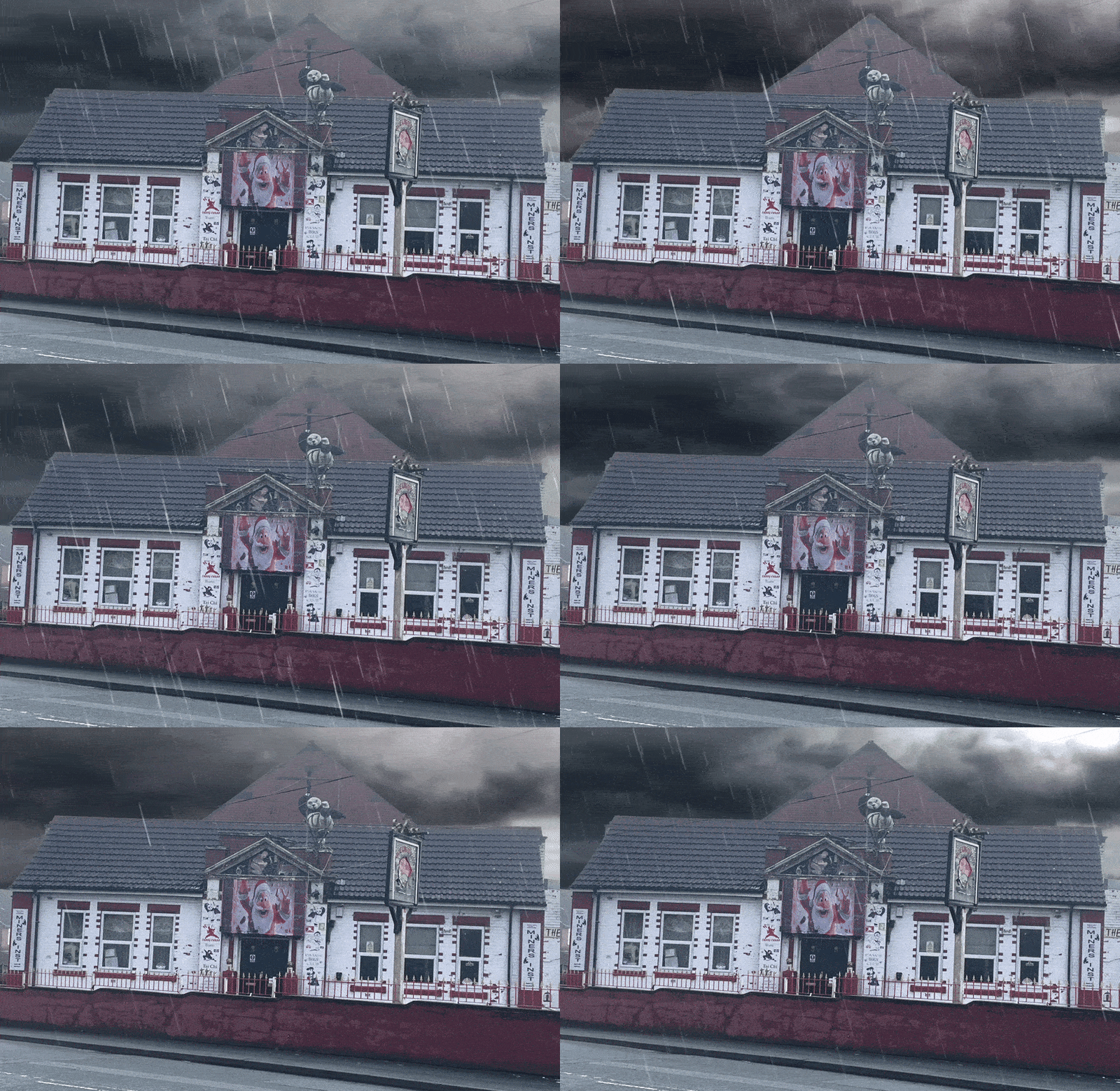
In February 1924 an exhibition of various acts took place at Moorthorpe Miner’s Institute, for the benefit of the rugby club, organised by Mr Pyecroft. Amusingly one of the acts was a demonstration of the wireless, which according to an account in the Penistone, Stocksbridge and Hoyland Express of 2nd February, led by Dan Godfrey, of Manchester’s regional station, 2ZY. Many such stations had their own military bands, and 2ZY in Manchester was at one time conducted by Harry Mortimer. In 1924 Dan Godfrey had formed the 2LO Military Band, later known as the Wireless Military Band and then the BBC Military Band. Dr Pyecroft was grateful for his assistance in bringing such a special technological demonstration to a little Yorkshire town, on the meeting of the formation of the South Elmsall Rugby Football Club in 1920, and for returning again in 1924.
On 15th March 1924 it was reported in the Sheffield Daily Telegraph that Sidney Price, aged 22, who had played for South Elmsall since the inception of the club, had turned professional and signed with Hull Kingston Rovers and had been named in their team to face Rochdale that day. Earlier in the season Price had represented the County in a ‘possibles’ versus ‘probables’ exhibition game. Price again made the papers on 21st March, when he was described by the Yorkshire Post as the “former South Elmsall Rugby Union scrummage half back”. On 7th June the Penistone, Stocksbridge and Hoyland Express published a player profile of George Gray, who had played for South Elmsall Rugby Football Club and was an all-round sports star, locally, having also been a crack bowler for South Elmsall Congs, in the Wombell Sunday School Cricket League. Gray had been a cricketer of note pre-war, but World War I interrupted his progress, and he was reportedly injured in conflict. Nevertheless, the report speculated that he was on trial with Hunslet, with a view to transferring to them next rugby season.
August of 1926 saw the Penistone, Stocksbridge and Hoyland Express reporting, on 14th August 1926, that Britton, a South Elmsall forward, had been signed by Hull Kingston Rovers for the next season. It is interesting that following a number of South Elmsall’s men being snapped up by professional rugby league teams, over the years, that in April 1928 the decision was made to form a new club under the auspices of the rugby league code. Involved with the new club’s formation were some familiar names, as reported on 17th April by the Sheffield Independent, including Mr W. Clayton as Secretary, in addition to committee members Mr E. Preston, Mr J. W. Tyas, Mr J. Kay, Mr E. Peat, Mr A. Broxholme, Mr A. Cartright, Mr A. Thomas and Mr F. Picken. The new club joined the Wakefield and District Junior League. The Sheffield Independent also reported on 10th August that a fundraising cricket match for the new club was to be held at Frickley Colliery’s cricket ground.
The new rugby league club wasted no time in bolstering their squad, on 31st August 1928 the Leeds Mercury reported they had signed J. Parkinson, “a promising centre” who had played the previous season with Kinsley, and who lived in Thorne. The new club’s first game was against Kinsley, in the Wakefield and District Junior League, at home. The team consisted of Pollitt, I. Fisher, Hempinstall, Richards, Gaskell, Hewitt, Carr, Thomas, Thompson, Clayton, Cartwright, Nicholson and G. Fisher, as reported on 1st September in the Sheffield Independent. In October 1928 the new club received another boost, when miners from Frickley Colliery allocated welfare funds to the club via a £200 grant, reported on 12th October in the Sheffield Independent. On 30th November the Sheffield Independent announced the South Elmsall team for their visit to Wakefield. This was; Sykes, Bartle, Robinson, Hempinstall, Wigglesworth, Ratchus, Mitchell, Fisher, Clayton, Wilson, Peatman, Heywood and Nicholson.
In February 1929 a bizarre road accident occurred, that led to the serous injury of a number of locals, including South Elmsall’s centre three quarter, John Hempinstall. A 26th February Yorkshire Post article outlined the accident. It was reported that Hempinstall was one of a number of miners who were on board a lorry, that was transporting them to Frickley Colliery, but after sliding on ice the lorry crashed through a shop window, on Barnsley Road. A number of the men were taken to Warde-Aldham hospital, some with horrific injuries, including one in a critical condition. Despite being thrown through the window, miraculously Hempinstall only suffered minor injuries. Hempinstall’s age was reported as 24 and he lived on Woodland View, Minsthorpe.
In June of 1929 the South Elmsall Rugby League Football Field was reported in the 1st June edition of the Penistone, Stocksbridge and Hoyland Express as the venue for a brass band concert, including the South Elmsall Tradesmen’s Cup. On Monday 22nd the Yorkshire Post reported that over 5,000 spectators had attended the contest, and that it was in aid of the South Elmsall Nursing and Maternity Homes, and promoted by Frickley Colliery Deputies.
On 24th August the Penistone, Stocksbridge and Hoyland Express gave an update on the state of the club’s ground and finances, whereby it was noted that the initial season had been marred by a “bad ground” but that a new purpose build ground had now been completed off Barnsley Road, in the centre of the town, with the headquarters being the Moorthorpe Hotel. It was hoped that this new ground would reap the rewards of large crowds, to boost the club’s finances. On 27th September a South Yorkshire Times article noted that Mr J. T. Slides had installed baths at the Moorthorpe Hotel for players and the ground was fully enclosed, the 28th September Sheffield Independent reported that a loan of £100 for ground improvements had been made by the Rugby League Council. This ground, unlike the previous ‘Common End’ ground, this new ground appeared on a number of Ordnance Survey maps. On 21st September the Leeds Mercury reported on the official opening of the new ground, where Alderman Gabriel Price, Mr A. Townend, Chaiman of the Yorkshire County Rugby League doing the honours and Mr J. Wilson, the Rugby League Secretary, expected to attend. The 27th September Yorkshire Times noted that Arthur Smith, President of the Frickley Colliery Athletic Club kicked off the club’s first game, at the grand opening, and 1,000 spectators were in attendance.
Retained from the previous season were; A. E. Peatman, H. Nicholson, G. Fisher, B. Beaumont, J. H. Heywood (all forwards), G. Hewitt (full back), I. I. Swaine and I. Fisher (wingers). In addition the club signed a number of higher profile players including; J. Whitwell (a full back from Castleford), R. E. Maskell (forward from Castleford), J. Millea (forward from York), E. Catterall (centre from Wigan Highfield), J. W. Hirst (centre from Featherstone), J. Kirkbright (centre from Castleford), N. Cowley (winger from Wigan Highfield), H. Needham (winger from Castleford) and possibly local man G. Otley of South Kirkby. The club Secretary was recorded as being Mr W. Clayton of 41 West Avenue, South Elmsall, Chairman was Mr E. Preston and trustees were Mr H. Hutton and Mr E. Peate. The committee included Mr C. Allis, Mr J. W. Tyas, Mr M. Dixon, Mr W. Cardwell, Mr G. Hewitt, Mr D. Peterkin, Mr E. Bates and Mr J. Stancliffe. In light of new optimism the club had agreed to enter the Yorkshire Junior Cup, the Rugby League Challenge Cup and the Wakefield and District Challenge Cup. By the first game of the new Wakefield Junior League season the team was; Whitwell, Catterall, Hirst, Cawley, Lowe, Mitchell, Maskill, Williams, Peatman, Heywood, G. Fisher and Clarkson, with Kirkbright and Miller reserves.
On September 30th the Sheffield Daily Telegraph reported that over 1,500 people had witnessed South Elmsall defeat Hopetown at home, and the club were at the top of the division, a remarkable turnaround from the previous season, when they finished rock bottom. On 3rd October the club signed former Castleford winger, George Croft. On the 5th of October the Penistone, Stocksbridge and Hoyland Express reported that stand off half back Joseph Ratchus had formally signed to the club, having had a trial with Wigan Highfield (though earlier reports suggest he had previously been with South Elmsall). The signings continued in October, with the 23rd October Leeds Mercury reporting that wing forward J. W. Slatter had signed from Wakefield Trinity, along with former Huddersfield hooker, W. Barlow. The 30th October edition announced that South Elmsall had raided Wigan for back John Bates and forward Peter Gaskill. It wasn’t all incomings though, the 31st October Yorkshire Post reported that Dewsbury had signed Frank Lowe, winger, from South Elmsall.
South Elmsall’s league form was superb and the club were also making waves in the most prestigious national rugby league competition, the Rugby League Challenge Cup. The 15th November Sheffield Independent reported that the club had reached the fourth qualifying round, and had drawn Stanley Rovers. This fixture caused controversy when South Elmsall defeated Stanley Rovers, who lodged a complaint that recently signed hooker, Barlow, was still a professional player signed to Huddersfield. The game was ordered to be replayed. In brighter news the same newspaper noted that South Elmsall were preparing to join the Rugby League, and were building up a large squad to do so, and had just added Herbert Barnes, the former Wigan and Barrow loose forward. Two more were added on 29th November, as reported by the Leeds Mercury, full back L. Lodge from Batley and centre three quarter F. Derbyshire, who had been on trial with Dewsbury (the South Yorkshire Times of the same date stated this was J. W. Derbyshire).
In December the club had reached the sixth qualifying round of the Rugby League Challenge Cup, having beaten Sharlston Rovers in the fifth qualifying round, and some regional commentators were openly speculating that a journey to Wembley may be a very real prospect. Having been drawn against Featherstone Juniors, it was noted in the 13th December South Yorkshire Times that some big name players were now wanting to join South Elmsall. Here though the dream appears fade, and the presses love affair with club began to unravel, when sixth qualifying round tie was lost. Having failed to reach the first round proper of the illustrious Challenge Cup the 18th January 1930 Penistone, Stocksbridge and Hoyland Express speculated that a number of players had been tempted from first class clubs only by players being signed on as employees of Frickley Colliery, as miners, in lieu of being professional employees of the rugby club directly, a setup also used by Frickley Colliery Football Club. Following the cup losses the clubs’ attendances plummeted, as interest in the project all but vanished. The less than flattering media coverage of this wage structure was challenged by Mr W. Clayton, Secretary of the club, in letters to the South Yorkshire Times, discussed in their publication of 24th January. He insisted that South Elmsall Rugby Club “do not pay a shilling in wages and have not paid anything to any club from which their players have come” and re-iterated that the club planned to gain entry to the Rugby League.
On 23rd January 1930 the club signed local man William Leigh, a forward, as reported by Leeds Mercury. On 13th February the Leeds Mercury reported that former Wakefield Trinity forward Joseph Woodcock had signed for South Elmsall. On the 17th February a match between South Elmsall and Sutcliffe’s was abandoned shortly after half time, when the referee fled the field of play. The Leeds Mercury noted that the referee had been threatened by two players who were engaged in a fist fight. The 5th April 1930 edition of the Sheffield Independent compared the clubs’ first and second seasons, and noted the stark contrast between them. In their first season South Elmsall had not won a league or cup game all year, but by this point in their second season the club had narrowly missed out on the first round proper of the Rugby League Challenge Cup, had reached the final of the Wakefield Junior League knockout cup and were still vying for the league championship. Sadly South Elmsall were beaten by Stanley Rovers in their Wakefield Junior League knockout cup final, at Wakefield Trinity’s Belle Vue stadium. However, the club did end the season as champions of the Wakefield Junior League. The club’s finances were published by the Leeds Mercury on 11th July 1930, which showed the club made a very small profit, with £412 receipts and £410 expenditure.
On 27th September 1930 the Leeds Mercury noted that South Elmsall had signed E. Brownhill (full back) and L. Taylor (scrum half) from Eastmoor, along with H. Ackroyd (stand off half) from Brotherton. The Leeds Mercury covered the strange transfer of a forward by the name of W. Gallagher, when on the 20th November 1930 they announced he had signed from Batley Celtic, and on the 3rd December that he had already returned back to Batley due to “travel difficulties”. On 17th December the Leeds Mercury reported that H. Lister and G. Nicholson had signed from Kinsley.
During the close season the rugby ground was used for a number of events, including boxing matches, that drew large crowds. Amusingly on the 16th of August 1930 three locals were fined at Pontefract Magistrates Court for using obscene language in the vicinity of the ground and trying to climb fences to get into the ground for free! Those found guilty included Rowland Pashley, a Haulage Hand of Moorthorpe, Albert Machon, a South Kirkby miner and Enoch Whitehouse, a miner from South Elmsall. Not everything was doom and gloom, in January 1931 two South Elmsall players, W. Williams and B. Beaumont, were selected to represent Yorkshire, as reported in the 22nd January Sheffield Independent.
Two new forwards were signed in January 1931, as reported in the 28th January Leeds Mercury. These were G. Lister (from Ryhill) and W. Bailey (from Upton). On 19th March 1931 the Sheffield Independent noted that W. Martin, a forward, had left to sign for Bramley. On 11th April 1931 the Leeds Mercury reported that Bradford Northern’s forward, E. Gledhill had signed for the club. A loose forward, Harry Pybus, was signed by the club, from Keighley, as reported on 15th July 1931’s Leeds Mercury. The Leeds Mercury reported on 7th May 1931 that Castleford had signed South Elmsall’s W. Harrison, a forward. Five new players were added in August 1931, as reported in the Leeds Mercury on 27th August. These included H. Ward (a centre from Hemsworth Colliery), W. Lodge and H. Marsdon (forwards from Kinsley), C. Grayton (a full back from Hall Green) and F. A. W. Guest (a forward from Hemsworth Grammar School). The 1st November 1931 Leeds Mercury noted that South Elmsall had signed Wakefield Trinity’s hooker, R. White.
On 12th November 1931 the Leeds Mercury reported that the club had signed stand off half J. D. Metcalfe, from Wakefield Trinity, along with Union convert S. Coulson, from Wakefield Rugby Union Club. December 29th 1931’s Leeds Mercury reported that South Elmsall had signed three players; I. Fletcher from Sharlston, H. Gorner from Grimethorpe and W. Johnson, from Wakefield Corporation. On 15th April 1932 a serious accident occurred on the road near Cherry Tree Farm, where South Elmsall player George Smith, reported in the Leeds Mercury as being 26 years of age and living on Valley Street, suffered leg injuries when the motorbike he was a passenger on was hit by a car. The motorbike was being driven by local boxing Champion, Eric Slatter, aged 21, of Harrow Street.
The rugby league club stumbled on for a two more years before capitulating in 1932, having never reached the ambitious heights of its committee, as an announced in the 19th August 1932 South Yorkshire Times.
Every so often former players continued to appear in local and regional press, for a few years after the club ceased to exist. On 19th January 1934 former South Elmsall forward B. Beaumont signed for Upton Rugby Club, as reported in the South Yorkshire Times. On Thursday 26th July 1936 another former South Elmsall player was in the news, when he signed as a Goalkeeper for Frickley Colliery. Edward Crossland, aged 24, had switched codes previously to Association football and had been playing football for South Elmsall United.
The rugby ground was used over the years for a number of local festivals, carnivals and sporting events, and on the 17th June 1933 the Penistone, Stocksbridge and Hoyland Express reported that Len Ledger planned to apply for a licence to convert it into a greyhound stadium, but this never happened. In September 1935 the pavilion of the South Elmsall rugby ground was burnt to the ground, with the facilities largely sat empty since the demise of the rugby club three years prior. As noted in the 23rd September edition of the Sheffield Independent, it was theorised that children set straw alight under the stands, which were constructed of wood and corrugated iron. In August of 1936 the South Yorkshire Times noted that a new football club, from Minsthorpe Lane Working Men’s Club, had been formed and would play in the South Kirkby League, with the field of the former South Elmsall rugby ground as their home. On 30th June the Leeds Mercury lamented the retirement of Dr Claude Pycroft, resident Surgeon at Warde-Aldham, with the opinion that him leaving South Elmsall would be losing one of it’s most active socialites who had formed many of the local sporting and recreational clubs. In another article, published on 3rd July 1936 in the South Yorkshire Times, I was noted that when the South Elmsall rugby union team folded their accounts still had money left over, which was used by Dr Pyecroft to by trophies for Hemsworth Grammar School.
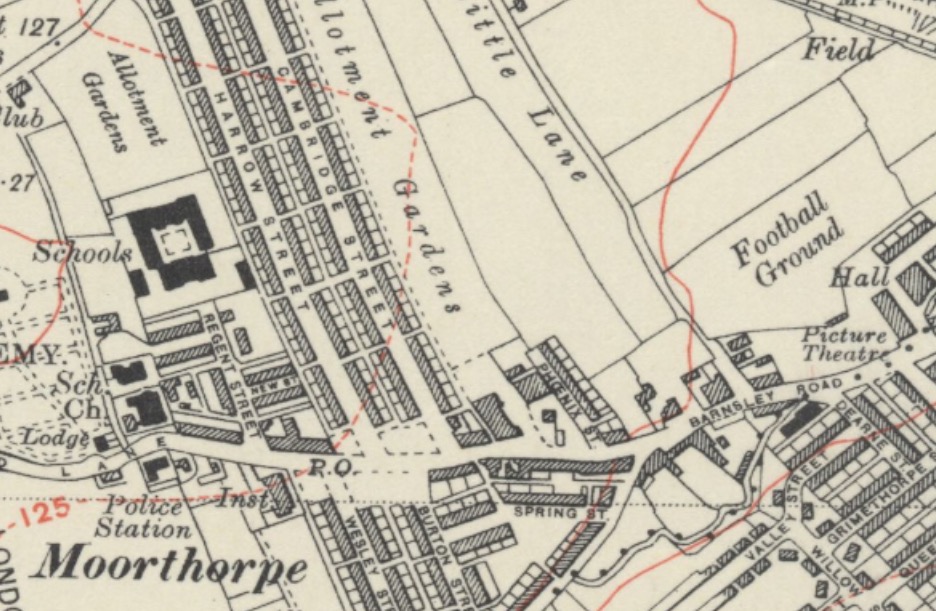
The land on which the former ground was located eventually was built upon by various buildings, including part of Addy Crescent and Beaumont Avenue, Today it is also partly the site of the Aldi car park and the White Rose Surgery.


 The Story of South Elmsall